
The five things that matter
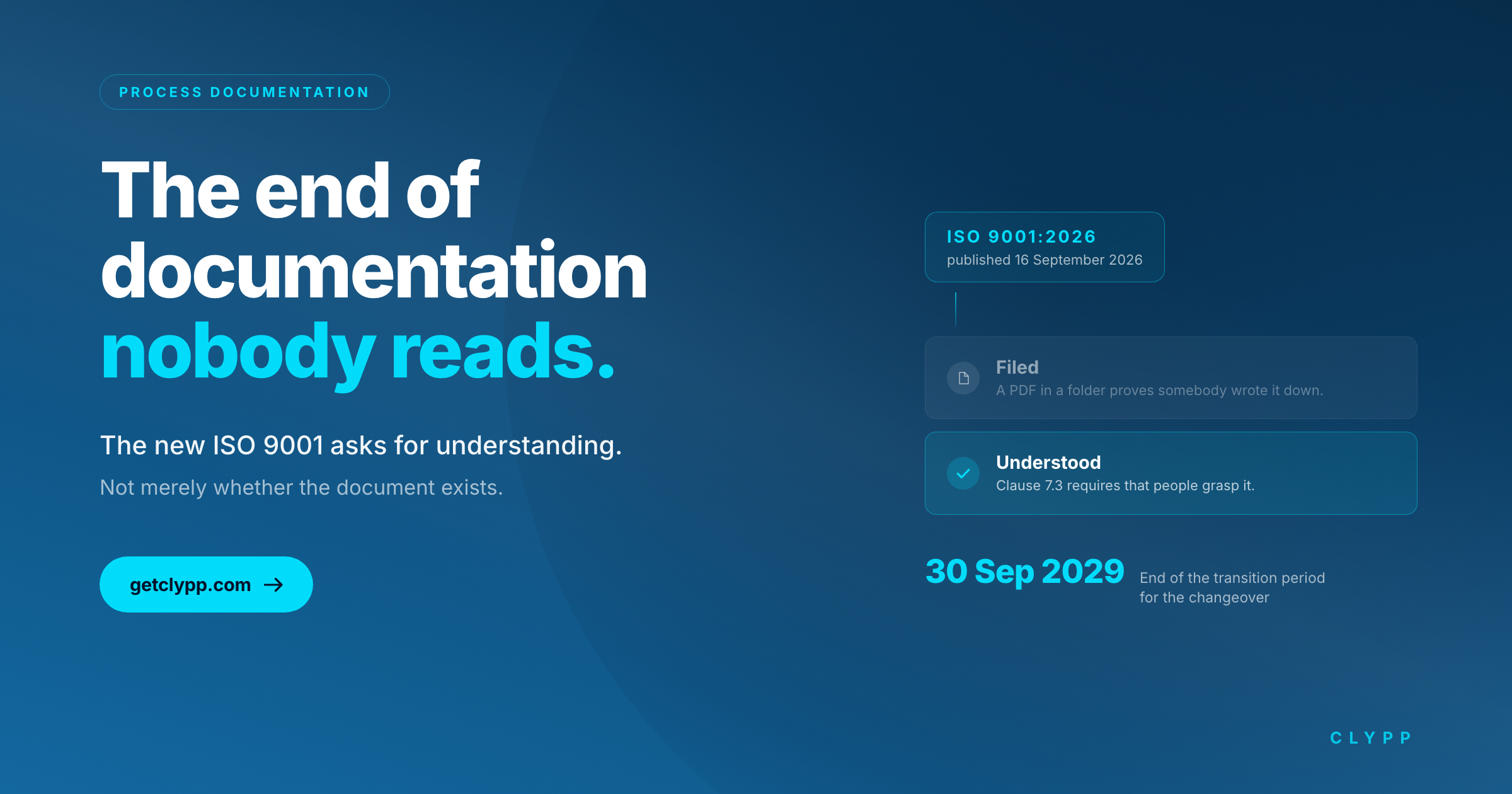
- ISO 9001 has been new since 16 September 2026. It replaces the 2015 edition. The transition period runs until 30 September 2029.
- The yardstick moves from the document to the understanding. Clause 7.3 now requires people to understand their organisation's quality culture — not merely that an instruction sits in a folder.
- The bottleneck is capture, not storage. Content has to be created first. That is precisely where most documentation projects fail.
- Demographics are closing the window. Germany's workforce will shrink by roughly 4.3 million people by 2036. Experience that was never written down leaves with them.
- Documentation has to be used to count. A format nobody opens satisfies neither the standard nor the purpose.
Shortly after ten in the morning on 16 September 2026, a notice went round the world's quality departments: the International Organization for Standardization had published a new edition of ISO 9001. Around a million organisations work to this standard. It is the most widely used management standard there is.
At first glance the revision is unspectacular. The structure stays, the principles stay, the core requirements stay. ISO itself stresses that this is a sharpening, not a fresh start.
At second glance it contains a shift that lands squarely on process documentation.
"The new ISO 9001:2026 marks a turning point that excites me as an auditor: at last the soft success factors move into normative focus."
Martina ScharweySenior Lead Auditor at DQS and TQM AssessorTranslated from GermanSource: DQS press release, 16 September 2026The standard now asks about understanding, not just filing
The decisive change sits in Clause 7.3. Until now it required people to know the quality policy and their contribution to the system. What is new is that they must understand their organisation's quality culture and its ethical behaviour.
ISO states the reasoning itself: new awareness requirements recognise that quality depends not only on effective processes but also on people's understanding of quality culture and ethical behaviour. Clause 5.1 places the same duty on leadership.
For documentation this means one thing. A filed PDF proves that somebody wrote something down. It does not prove that anybody understood it.
What actually changes with ISO 9001:2026
- Clause 5.1 — Leadership: top management must actively promote quality culture and ethical behaviour.
- Clause 5.2 — Policy: the quality policy is tied more explicitly to context and strategic direction.
- Clause 6.1 — Risks and opportunities: the two are distinguished more clearly.
- Clause 7.3 — Awareness: people must understand quality culture and ethical behaviour.
- Annex A — new: clarifies key concepts and the intent behind the requirements.
Customer focus, the process approach, risk-based thinking and continual improvement remain unchanged. So does the consideration of climate change introduced by the 2024 amendment. The German edition, DIN EN ISO 9001, is expected in November 2026.
The bottleneck is capture, not storage
Organisations that want to improve process documentation usually buy a filing system: a wiki, a knowledge base, a quality management portal. The problem sits one step earlier.
Few people know this better than the man who founded process modelling in the German-speaking world. August-Wilhelm Scheer created ARIS, the framework companies have used to describe their operations since the 1990s.
"Whether you represent content through models or through text, in either case it first has to be generated."
Prof. Dr. August-Wilhelm ScheerCreator of the ARIS architecture, founder of IDS Scheer AGTranslated from GermanSource: IM+io, interview of 1 December 2023The sentence sounds banal and describes the most expensive bottleneck in quality management. The person who has mastered the process has no time to write it down. The person who has time does not perform it. That this bottleneck can now be dissolved with AI is the real news of the past three years.
What gets lost along the way has a name.
Tacit knowledge: why the most important part is never in the manual
The chemist and philosopher of science Michael Polanyi coined the term tacit knowledge in 1966. His opening line: "We can know more than we can tell."
He meant the competence that escapes language. The machine operator hears that something is wrong before a sensor fires. The setter knows that this particular tool needs two hundredths more preload. Nobody ever wrote it down, because nobody ever put it into words.
This is exactly the knowledge that leaves a company with every retirement — and exactly the knowledge least likely to survive the jump into a text document.
Demographics turn a nice-to-have into a deadline
Process documentation was long treated as something you do when there is time. That time is running out, and the arithmetic says so.
In June 2026 the German Economic Institute did the maths: by 2036 the working-age population will shrink by around 4.3 million people to roughly 51 million. Two years earlier the institute had still expected three million. Each year about 1.3 million people retire while some 800,000 enter the workforce.
"Germany is not facing demographic change — it is already in the middle of it."
Holger SchäferLabour market economist at the German Economic Institute (IW), CologneTranslated from GermanSource: IW Cologne, 15 June 2026For documentation this creates an uncomfortable simultaneity. The need for trained staff rises exactly when the people who could train them are leaving.
Good process documentation has five recognisable properties
From the new normative position and the demographic pressure a yardstick emerges that holds regardless of the tool in use.
It is created where the process runs. Whoever masters the workflow captures it themselves, without a detour through an editorial team.
It actually gets opened. Usage data is the most honest quality indicator documentation can have.
It survives change. A workflow that changes must be recapturable in minutes, not in an editorial cycle.
It carries its own evidence. Version, authorship and timestamp arise as a by-product, not as a separate compliance exercise.
It reaches people in their language. On production teams with several mother tongues, this decides whether an instruction lands at all.
"Away from pure process consideration, towards lived identity and shared values."
Martina ScharweySenior Lead Auditor at DQS and TQM AssessorTranslated from GermanSource: DQS press release, 16 September 2026There is time until September 2029 — but less than it sounds
The transition period ends on 30 September 2029. For most organisations the changeover will fall into a routine surveillance or recertification audit. A separate assessment is usually unnecessary.
ISO recommends a sequence that explicitly goes beyond ticking boxes: understand the changes, assess your current system through a gap analysis, update processes and documented information where useful, engage your people, and plan the transition with your certification body.
"ISO 9001:2026 puts opportunities more firmly at the centre and separates how they are handled more clearly from the consideration of risk."
Prof. Dr. Patricia AdamMember of ISO standardisation committees for ISO 9000/9001 and ISO 31000, DQS auditorTranslated from GermanSource: DQS press release, 16 September 2026The third step is the interesting one. ISO itself writes that organisations should take the opportunity to simplify, streamline or improve. A revision is the rare moment when nobody complains if an 80-page manual shrinks to what people actually read.
Frequently asked questions about process documentation
What is process documentation?
Process documentation is the structured description of how an activity actually runs in an organisation — with steps, responsibilities, required resources and check points. It differs from process modelling in that it is written for execution rather than for analysis.
Is process documentation a legal requirement?
There is no general legal obligation. It becomes mandatory through standards and sector law: ISO 9001 requires documented information for a quality management system, often in the form of work instructions; in Germany the GoBD require procedural documentation for tax-relevant processes; regulated industries add their own requirements.
What does ISO 9001:2026 change for documentation?
Beyond the existence of documents, the standard now requires people to understand their organisation's quality culture (Clause 7.3) and leadership to actively promote it (Clause 5.1). That moves the question of whether documentation lands to the foreground — not merely whether it exists.
How detailed does process documentation need to be?
Detailed enough that a trained person can perform the process without asking, and brief enough that they actually read it. The most common mistake is not too little detail but too much context nobody needs.
Who should document processes?
The person who performs the process. Every translation step between execution and document costs accuracy and time. Central editorial teams make sense for approval and structure, not for capture.
Why do documented processes go stale so quickly?
Because updating usually costs more than ignoring. If a change triggers an editorial cycle, it does not get reported. Documentation stays current only when updating costs less effort than working around it.
What happens to experience nobody can write down?
It can be shown even when it cannot be phrased. That is the difference between text that describes and a recording that demonstrates — the reason video-based formats carry tacit knowledge better than prose.
About Clypp
Clypp is a software platform from Germany that lets employees record their own workflows and turns those recordings automatically into structured guides — with steps, screenshots, voice-over and translations. Recording takes minutes; the result can be exported as video, PDF or SCORM package and embedded in Microsoft Teams, an LMS or a wiki.
Version, authorship and timestamp are generated automatically — the very evidence a quality management system needs anyway. Data is stored exclusively on EU servers; Clypp is ISO 27001 certified and GDPR compliant.
The experts quoted
Martina Scharwey
Senior Lead Auditor at DQS, TQM Assessor
Scharwey audits quality management systems for DQS, one of the largest certification bodies in the German-speaking world. As a TQM assessor she evaluates organisations beyond mere conformity. Her assessment of the revision dates from the day of publication, 16 September 2026.
Prof. Dr. Patricia Adam
Member of ISO standardisation committees for ISO 9000/9001 and ISO 31000
Adam helps write the standards that others later debate. She is also a DQS auditor and EFQM assessor, and reads the revision from the perspective of committee work.
Prof. Dr. August-Wilhelm Scheer
Creator of the ARIS architecture, founder of IDS Scheer AG
At Saarland University Scheer developed the Architecture of Integrated Information Systems and the event-driven process chain method. Both still shape how business processes are discussed across the German-speaking world.
Holger Schäfer
Labour market economist at the German Economic Institute (IW), Cologne
Schäfer researches the German labour market at the IW. Together with Philipp Deschermeier he published the June 2026 projection on the retirement of the baby boomer cohorts, the source of the figures cited here.
Sources
- ISO, ISO 9001:2026 — What businesses need to know, accessed 22 September 2026.
- DQS Holding GmbH, press release "ISO 9001:2026 veröffentlicht: Qualität wird zur Führungsaufgabe", 16 September 2026.
- DIN Media, topic page "Revision der ISO 9001 — Veröffentlichung 2026", accessed 22 September 2026.
- German Economic Institute (IW) Cologne, "Babyboomer in Rente: Bis 2036 fehlen 4,3 Millionen Arbeitskräfte", 15 June 2026, authors Holger Schäfer and Philipp Deschermeier.
- IM+io magazine, interview "Die Antwort liegt im Modellieren" with August-Wilhelm Scheer, conducted by Tobias Greff, 1 December 2023.
- Michael Polanyi, The Tacit Dimension, Doubleday, New York 1966.
Published 22 September 2026. All quotations were verified against the original source on the day of publication. Quotations marked as translated were given in German in the original.

