
What is process documentation?
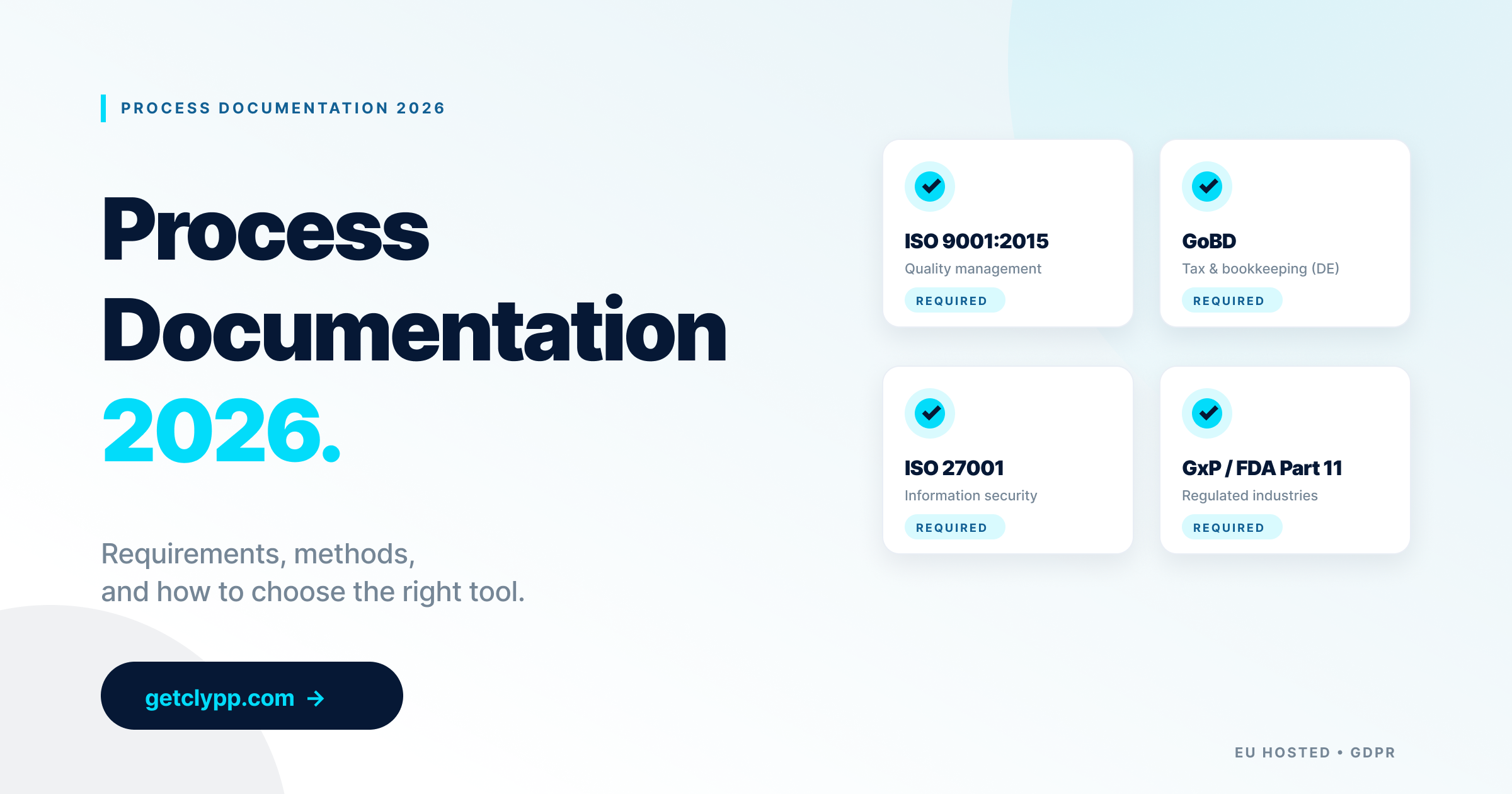
Process documentation is the structured recording of business processes, step-by-step descriptions of how a task is performed, by whom, with which inputs and which expected outputs. It is required for tax-relevant processes under European GoBD rules (BMF letter of 14 July 2025), for certified quality management systems under DIN EN ISO 9001:2015, and for industry-specific standards (e.g. GxP for pharmaceuticals). Modern process documentation is increasingly produced as video. With AI tools like Clypp, a process can be recorded in 5–10 minutes and automatically converted into a structured, audit-compliant SOP with steps, screenshots, voice-over and translations.
Why process documentation matters more in 2026 than ever
Three developments have pushed the topic to the top of the agenda over the last twelve months. First, the GoBD were updated in July 2025, and the e-invoicing requirement that took effect 1 January 2025 means every receipt, validation and archiving step for electronic invoices must be documented end-to-end. Second, ISO 9001 and industry-specific standards keep tightening the bar, processes must not only be documented, but provably lived. Third, the skills shortage has made it operationally critical: organisations that do not document processes lose institutional knowledge with every resignation.
The classic answer was BPMN diagrams and 40-page PDFs. Both share the same problem: they get written, filed once, and then never read. The SAVO Group put a hard number on it, employees forget around 65% of training material within seven days and roughly 90% after six months.
Legal and standards-based requirements
GoBD and procedural documentation (Verfahrensdokumentation)
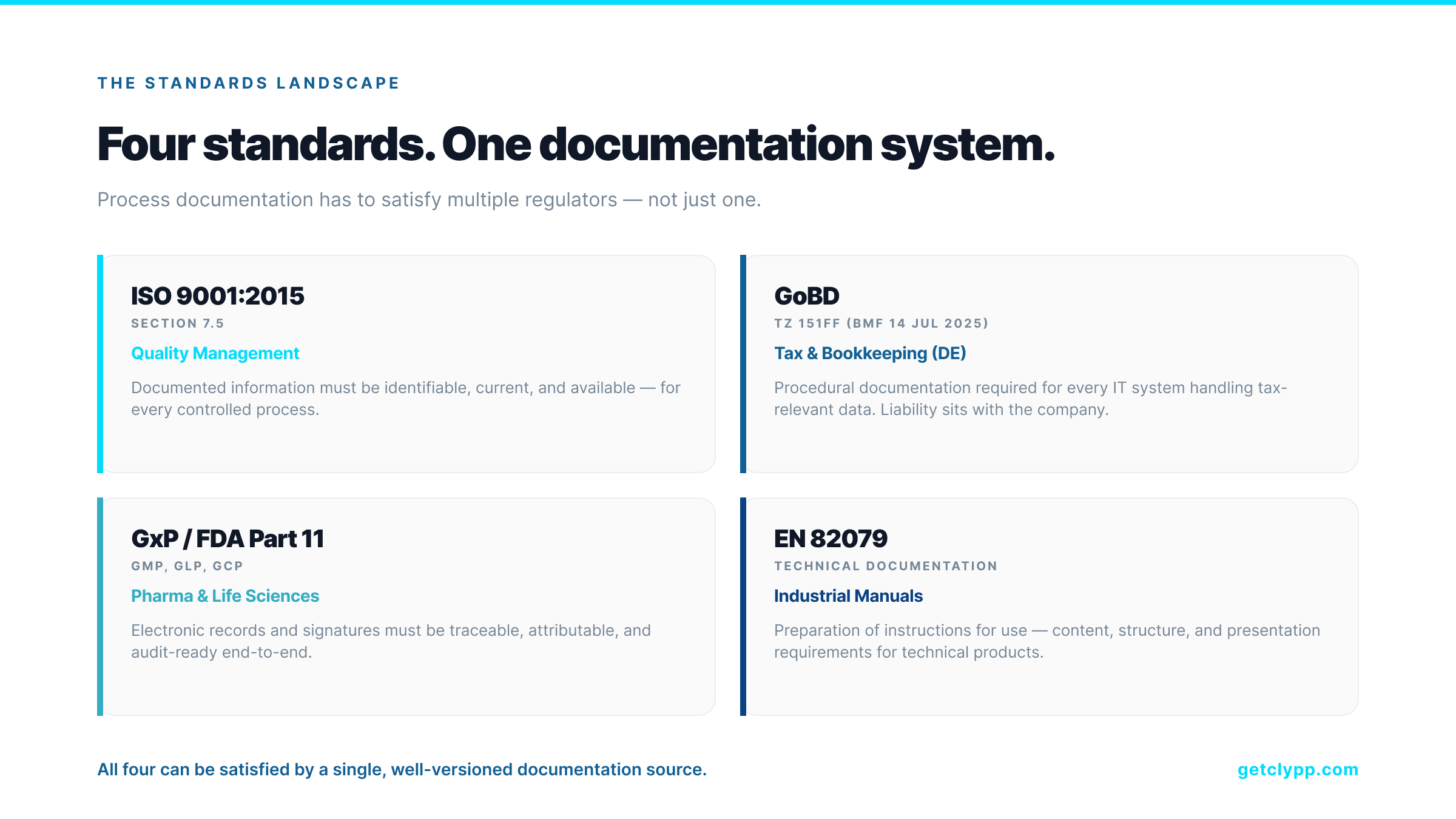
The German GoBD (“Principles for the Proper Management and Storage of Books, Records and Documents in Electronic Form”) require a procedural documentation for every IT system handling tax-relevant data (Tz 151ff GoBD). It must allow a competent third party (typically the tax auditor) to fully understand the digital bookkeeping processes within a reasonable time. Legal responsibility lies with the company, not its tax advisor.
The core requirements come down to six points:
• Traceability and verifiability of every business transaction
• Completeness of all process steps
• Accuracy (documented process = actual process)
• Timeliness of recording
• Immutability of data
• End-to-end documentation of receipt, processing and archiving
ISO 9001:2015 (Section 7.5, Documented Information)
ISO 9001 does not mandate a specific documentation format. What it requires is control: every document must be identifiable (title, date, author, version), current and available to the relevant employees. Which processes to document is the organisation’s decision, based on size, complexity and risk profile.
Industry-specific standards
Pharmaceutical operations are governed by FDA Part 11 and GxP (GMP, GLP). Technical documentation falls under EN 82079. Heavily regulated sectors (banking, insurance, medical devices, energy) add further compliance layers. They all share one trait: process documentation must not just exist on paper, it must be demonstrably followed.
Methods of process documentation
BPMN 2.0, the notation standard
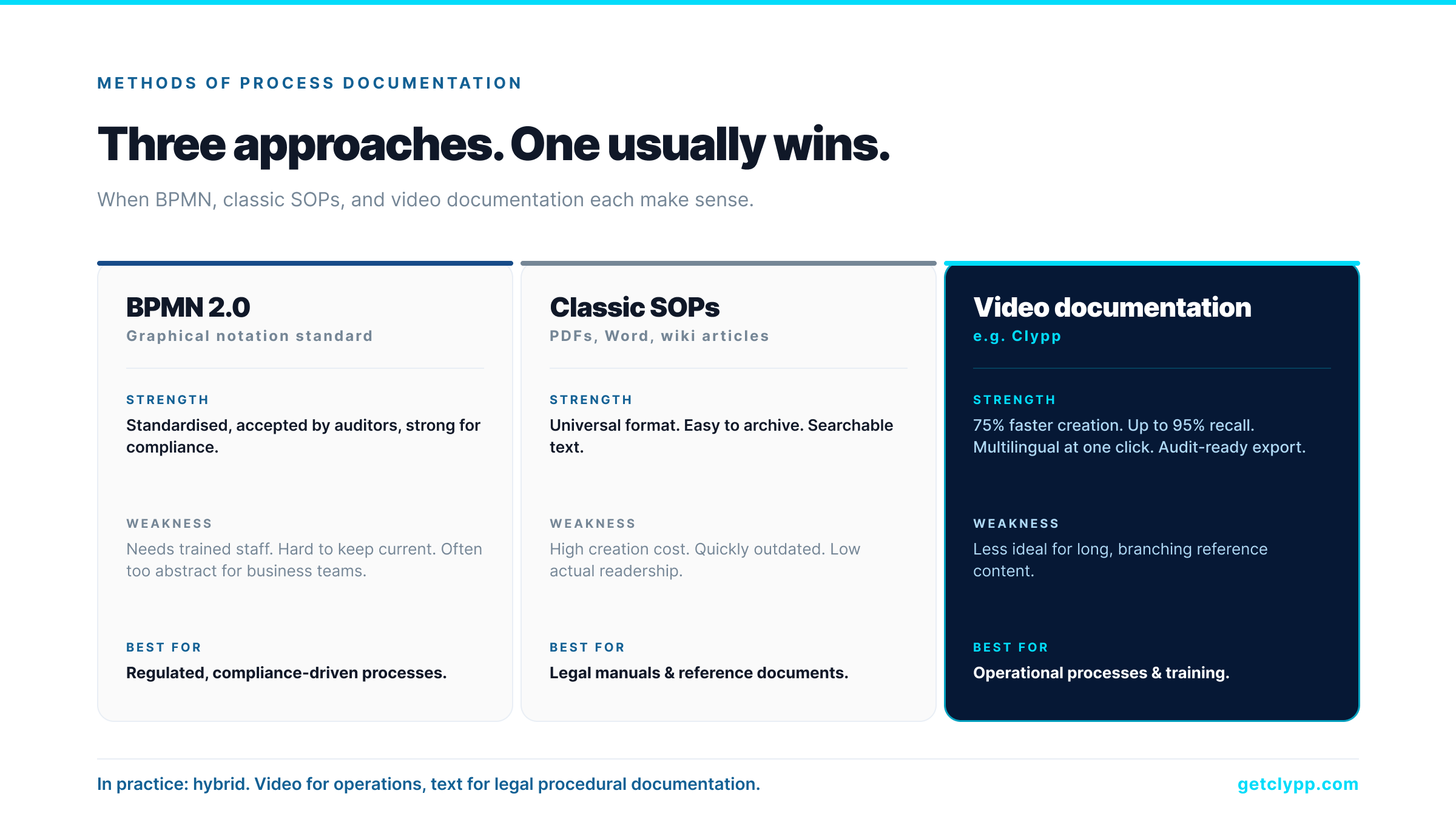
Business Process Model and Notation (BPMN 2.0) is the established standard for graphical process modelling. Strength: standardised, accepted by auditors, strong for compliance. Weakness: requires trained staff, hard to keep current in day-to-day operations, often perceived as too abstract by business teams.
Classic procedural documents and SOPs
PDFs, Word files, wiki articles. Strength: universal and easy to archive. Weakness: high creation cost, quickly outdated, low actual readership. For many processes this is still the default, but rarely the most efficient choice.
Video process documentation
Recording replaces writing. The subject-matter expert records the process once on screen or smartphone; AI extracts the steps, builds a structured SOP with screenshots, translates everything, and exports the result as video, PDF or SCORM. Strength: up to 75% faster creation, dramatically higher recall, multilingual at one click. Weakness: for purely textual procedural documentation (e.g. legal compliance manuals), text remains the right answer.
In practice the hybrid approach wins: video for operational processes, text for the legal procedural documentation, both versioned and cross-linked.
Text vs. video process documentation, direct comparison
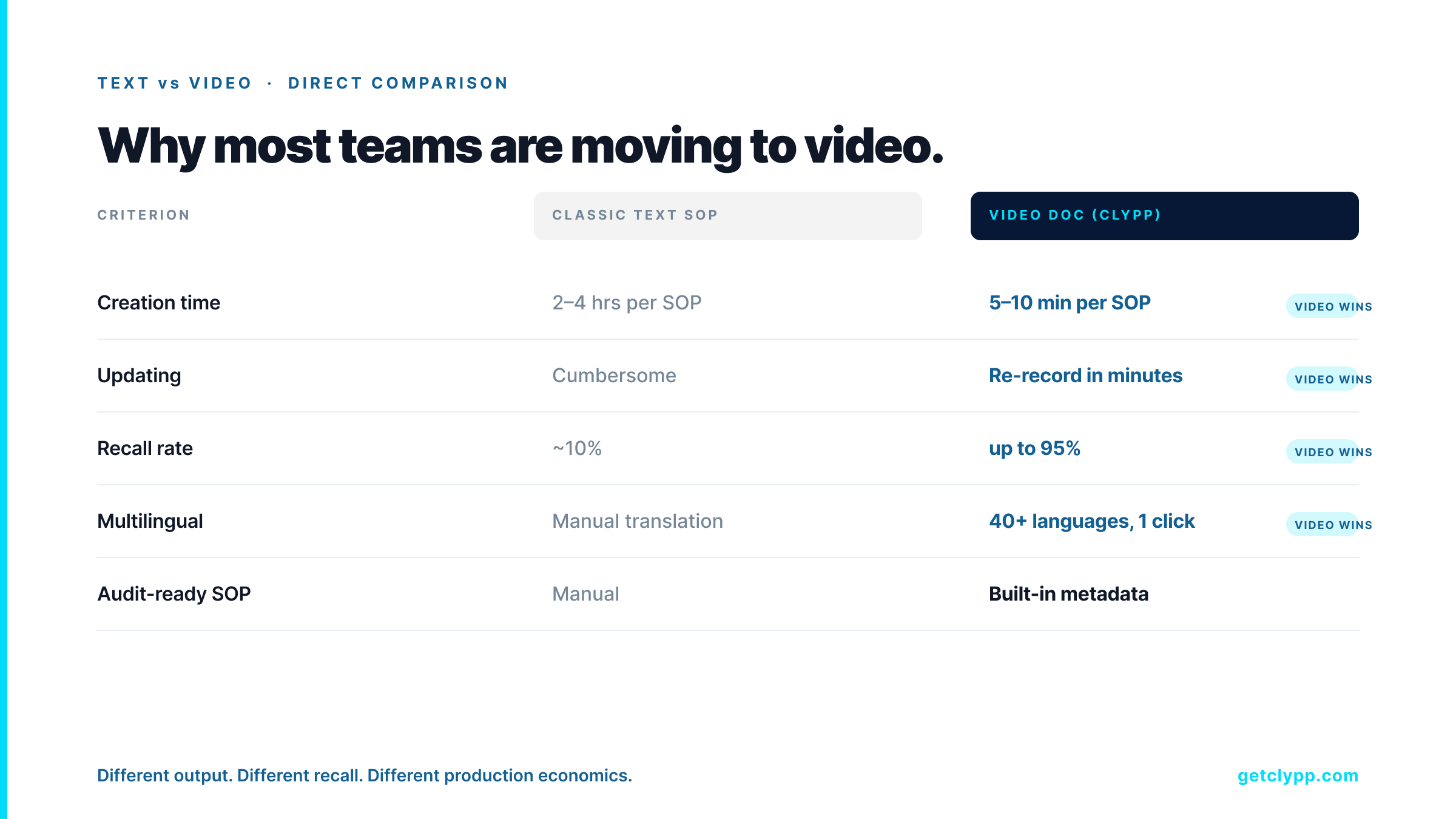
| Criterion | Classic text documentation | Video process documentation e.g. Clypp |
|---|---|---|
| Creation time per SOP | 2–4 hours writing + screenshots | 5–10 minutes recording |
| Updating | Cumbersome, often outdated | Re-record in minutes |
| Recall rate | ~10% after reading (Research.com 2026) | Up to 95% after viewing |
| Multilingual | Manual translation per document | Automatic in 100+ languages |
| ISO 9001 / GoBD-ready | Yes, with versioning | Yes, plus training tracking |
| Audit-compliant SOP export | Manual | Built-in (versions, author, timestamp) |
| GDPR + EU hosting | Vendor-dependent | Default at Clypp (EU servers, ISO 27001) |
How a video process documentation is created in five steps
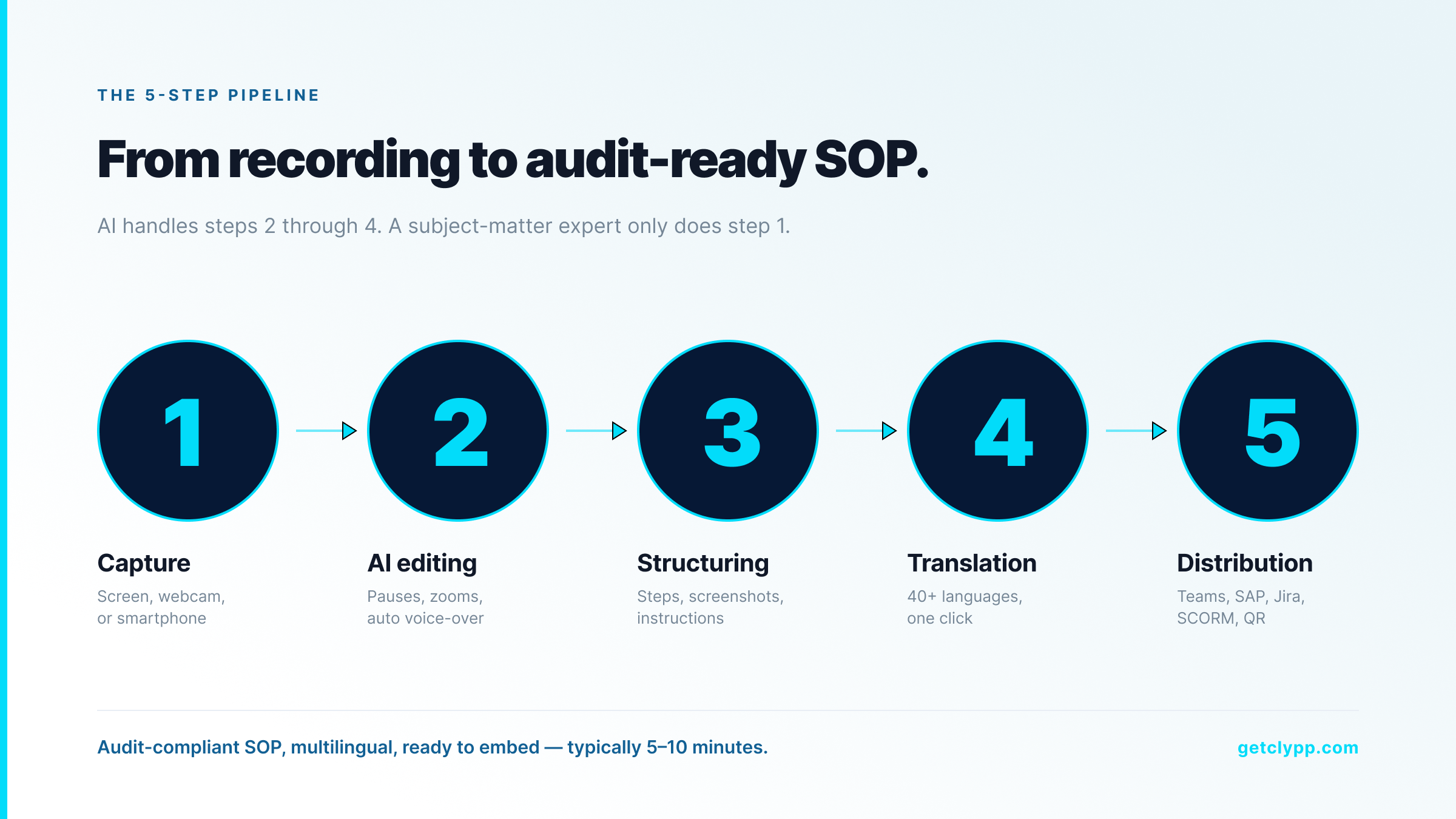
1. Capture: employees record screen, webcam or smartphone, directly in the browser, no download.
2. AI-powered editing: pauses are removed, the active region is zoomed, an authentic-sounding voice-over is generated.
3. Structuring: AI segments the process into steps with headings, screenshots and instructions, the finished SOP.
4. Translation: subtitles, voice-over and on-screen text translated into 100+ languages with one click.
5. Distribution: output as video, MP4, PDF or SCORM, embedded in Microsoft Teams, SAP, Jira or via QR code at the workstation.
Clypp, process documentation built in Germany
Clypp is an AI-powered platform for video process documentation, developed by Zesavi GmbH in Munich. Founders Maximilian Zeyda and Edwin Sauer met at TU Munich and launched the product in 2020, with the goal of moving process documentation out of the hands of technical writers and into the hands of the people who actually run the processes.

For European buyers, three points are decisive:
• EU hosting: data is stored exclusively on servers within the European Union.
• ISO 27001 certification: recognised audit standard for information security.
• GDPR alignment: built around European data protection law, no third-country contractual workaround required.
Clypp is used by Elementar Analysensysteme GmbH, Rosenberger Hochfrequenztechnik and Unternehmensgruppe Nassauische Heimstätte, among others. Native integrations for Microsoft Teams, Atlassian Trello, Jira and SAP cover the tools where process documentation is actually consumed.
Particularly relevant for regulated industries: Clypp exports audit-compliant SOPs (structured, step-by-step documents with version, author and timestamp metadata) directly usable for ISO audits, GoBD procedural documentation and internal control systems. A recording is not just a training video; it is a defensible compliance document.
A z is available for small teams without a credit card.
ROI: a worked example
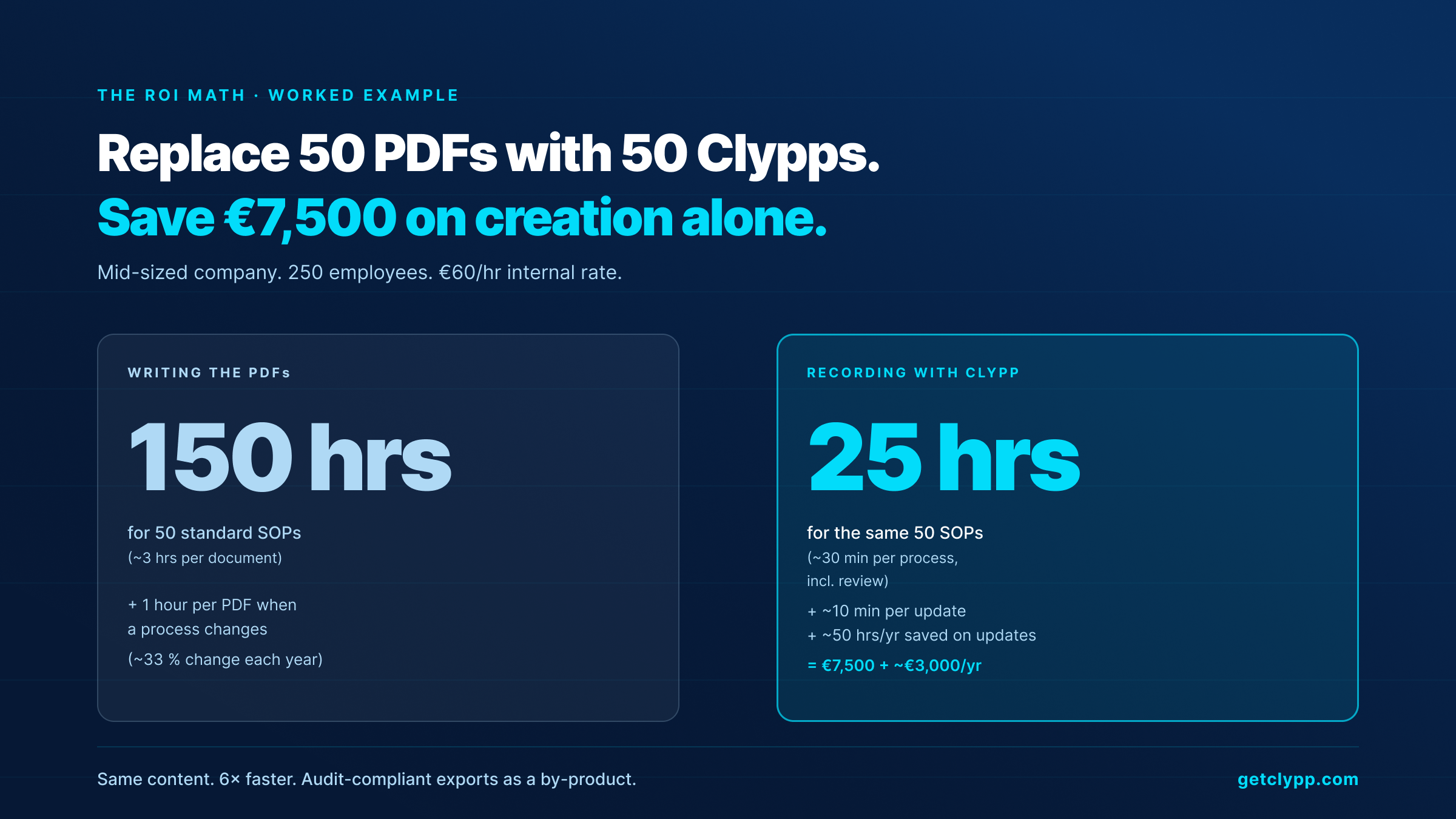
A mid-sized company with 250 employees replaces 50 standard SOPs with video versions. Creating the original PDFs averaged 3 hours per document, 150 hours total. With Clypp, re-recording takes around 30 minutes per process including review, 25 hours total.
At an internal hourly rate of €60, that is roughly €7,500 saved on creation alone. Add ongoing updates: about a third of processes change each year. Where updating a PDF section typically takes an hour, a fresh Clypp recording is done in 10 minutes, another ~50 hours saved per year.
On top of that come the non-monetary effects: higher recall, faster onboarding, less dependency on individual knowledge holders, and audit-compliant documentation that emerges as a by-product of the work, without separate effort for ISO and GoBD reviews.
Frequently asked questions
Is video process documentation GoBD-compliant?
Yes, provided the underlying platform meets the GoBD requirements: versioning, immutability, traceability of changes, complete archiving. Clypp exports audit-compliant SOPs as structured step-by-step documents with version, author and timestamp, directly usable for GoBD procedural documentation, ISO audits and internal control systems. Important: video does not replace the legal procedural documentation for bookkeeping processes. It complements it. The textual procedural document remains required; the video makes it usable.
Where is Clypp data stored?
Exclusively on servers within the European Union. Clypp is ISO 27001-certified and fully GDPR-aligned, a key reason platforms in regulated industries choose it.
Do employees need video editing skills?
No. Clypp is designed for non-editors. AI handles cuts, zooms, voice-over and structuring. Customers report employees creating productive videos within minutes, with no prior training.
Does Clypp work with Citrix or VPN?
Yes. Clypp runs in the browser and works with Citrix Gateway, AnyDesk and similar VPN setups standard in many DACH organisations.
How many languages does the auto-translation support?
More than 100, including all relevant European languages plus Arabic, Mandarin, Japanese and Hindi. Subtitles, voice-over, titles, descriptions and even on-screen text are translated, at one click.
Can I connect Clypp to our LMS?
Yes. Clypp exports SCORM packages for common Learning Management Systems. Native embedding into Microsoft Teams, plus universal embed codes for Confluence, SharePoint, wiki systems and intranets.
Does Clypp produce audit-ready documentation?
Yes. Clypp exports structured SOPs with version, author and timestamp metadata, directly usable for ISO 9001 audits, GoBD procedural documentation and internal control systems.
Bottom line
In 2026 process documentation is neither optional nor a pure compliance chore. It is an operational lever, against knowledge loss, against the consequences of the skills shortage, against the forgetting curve. Classic text SOPs satisfy the legal requirements but routinely fail at consumption. Video-based, AI-assisted process documentation closes that gap: up to 75% less creation time, up to 95% recall, automatic multilingual delivery, EU-compliant storage, and audit-ready exports as a by-product.
Whether things get documented is decided by effort, not by the rule.
ISO 9001 and tax-record rules say what has to exist. They do not say why it is so often missing. The reason is mundane: documenting costs time nobody has during the working day. Drop the effort to two minutes and the reason disappears.
- Document while the work happens: screen or smartphone, one pass.
- The written guide is produced with it: for the file and the audit, not just a film.
- Updating means re-recording: which is why it stays current.
Clypp is a software platform from Germany for video work instructions. In use at RATIONAL, Rosenberger and Elementar, among others.

