
Key takeaways
- An LMS is a system of record: assign, document, certify. At that job it is unmatched, 41 percent of companies rate it the most successful element of their learning ecosystem, against 15 percent for learning experience platforms.
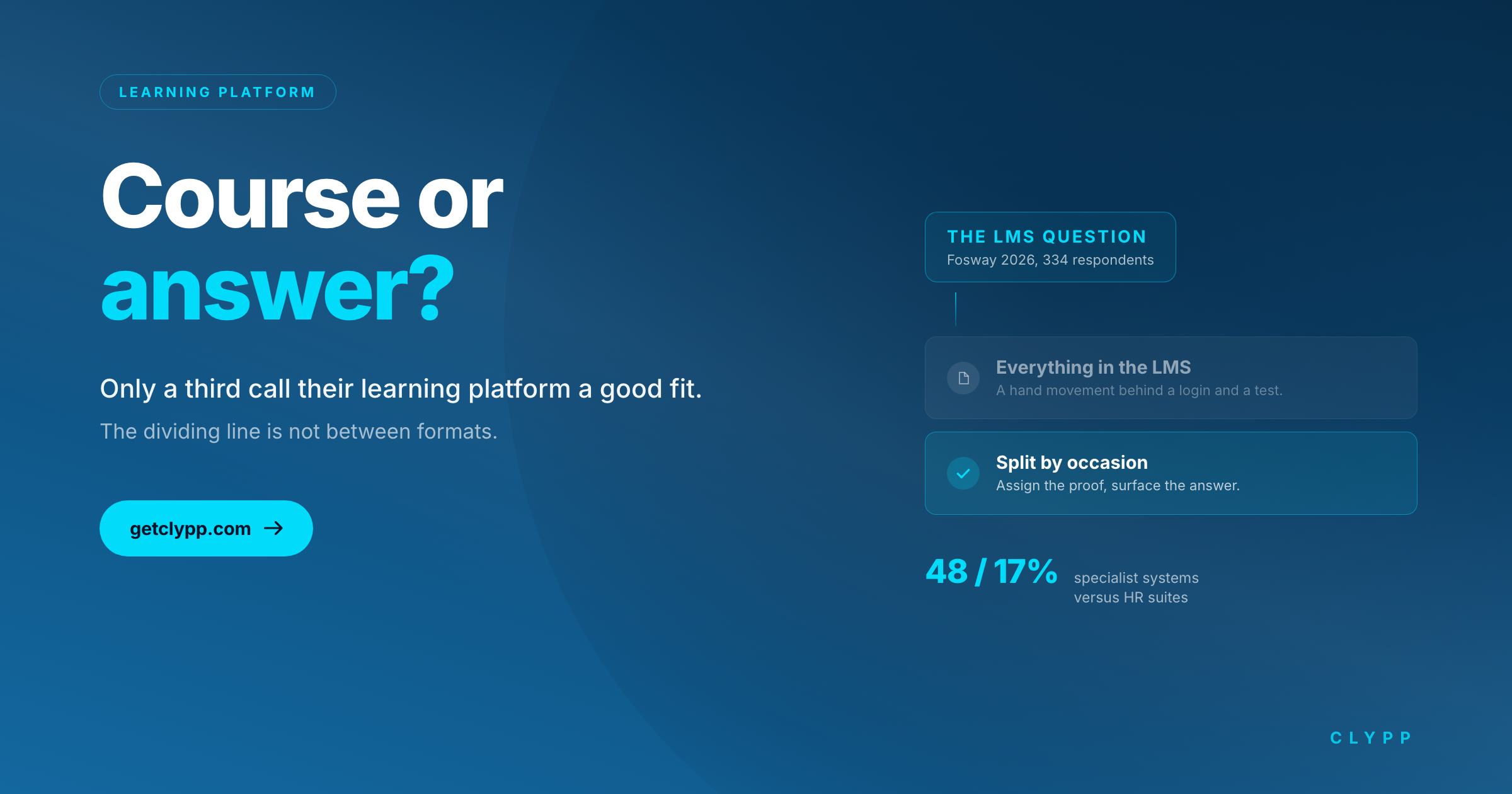
- Even so, only about a third of the L&D teams surveyed consider their learning platform a good fit for what a modern workforce needs.
- Specialist systems beat HR suites by a wide margin: 48 against 17 percent. Only twelve percent of organisations use the learning module inside their HR software at all.
- Experts are cooling on learning video too: video tutorials fell from 90 to 79 percent on central importance within a year. The study's own authors say the reason is unexplained.
- The useful dividing line is not between formats but between occasions: does this person need a course or an answer?
The question almost always arrives in the same shape. A manufacturer has started capturing work steps on video. It works, the library grows, and eventually somebody from people development says: surely all of this belongs in the LMS.
There is a sensible worry behind that. Knowledge scattered everywhere is knowledge nobody finds. But the question "which LMS should we buy?" routinely skips past the decision that actually matters. A learning platform is not built to help someone in the moment they are standing at a machine and stuck.
"Market discourse often sounds as though immersive, agentic or coach-like interfaces had already displaced classic formats. Empirically, that is not supported."
Gudrun PorathSpecialist journalist on digital learningTranslated from GermanSource: Haufe, 23 April 2026
An LMS manages learning. It does not answer questions
A learning management system is, historically, an administrative system. It assigns content, records who worked through it, and produces proof at the end. That is what it was built for, and it is very good at it.
That is no small thing. Anyone who has to document safety briefings, maintain qualification matrices or demonstrate in an audit who was trained and when needs a system that enforces completeness. A video library does not do that.
The numbers bear the division of labour out. In the "Digital Learning Realities" research by the analyst firm Fosway, 41 percent of companies rated the classic LMS the most successful element of their learning ecosystem, with a further 36 percent calling it quite successful. The newer learning experience platforms, marketed for years as the "Netflix of learning", reached 15 and 11 percent.
So the LMS is not dead. It is simply built for one particular job.
SCORM: the connector between video and learning platform
SCORM is not a file format like MP4. It is a packaging convention. A SCORM package contains the content plus a description of how the learning platform should handle it: when something counts as completed, what result is reported back, how progress is stored.
The practical benefit: a video exported as a SCORM package appears in the LMS not as a bare link but as a completable unit with a status. That is what turns "clicked on it" into defensible proof.
Which is why "video or learning platform?" is usually the wrong question. SCORM already connects the two. The interesting question is which content should travel that route at all.
Why only a third consider their own platform fit for purpose
As clear as the LMS's strength is, the dissatisfaction is just as clear. In the current edition of the same research series (334 respondents from HR, talent and L&D functions, surveyed between February and April 2026, over three quarters of them in European organisations) only around a third consider their learning platform a good fit for what modern workforces need.
The gap between two architectures is especially stark. Specialist learning platforms are rated suitable by 48 percent of their users. Learning modules that form part of a large HR suite reach 17 percent. And only twelve percent of organisations work with their HR software's learning module at all.
For any company currently preparing a decision, that is the most practically useful figure of the year: the learning module that comes "included" with existing HR software is rarely the cheap option it appears to be.
A second finding deserves attention because it cuts against the mood of the moment. 73 percent of respondents are less satisfied with the AI features of their existing learning systems than they expected, even though 67 percent name artificial intelligence as a strategic priority. Expectation is currently outrunning reality.
Why even experts are backing away from learning video
At this point a finding belongs in the text that a provider of video documentation has no particular reason to enjoy.
The mmb Institute in Essen has surveyed education professionals annually since 2006 on which learning technologies will matter over the coming three years. In the twentieth wave (77 experts, surveyed between December 2025 and February 2026) video tutorials lost ground sharply: from 90 percent the previous year to 79. On expected commercial success the drop was 19 percentage points. Chatbots and learning assistants took the top spot instead, at 95 percent.
The study offers a possible explanation: a displacement effect. Someone with a specific question gets an immediate answer from a chatbot instead of hunting through a media library for the right video. What is notable is how carefully the authors handle it.
"What the respondents' scepticism behind this marked downgrade rests on would require a separate survey."
Dr Lutz Goertz and Dr Lutz P. MichelAuthors of the mmb Trendmonitor 2025/2026Translated from GermanSource: mmb Trendmonitor 2025/2026, page 10 (PDF)
Two qualifications matter here, so the number is not asked to carry more than it can. First, education-industry professionals were asked for their expectations, not companies for their practice. Second, the subject is pre-produced e-learning formats, the explainer film commissioned from an agency. A recording an employee makes at her own machine to capture a changeover is a different object: it does not compete with a chatbot for attention, it is the source such a chatbot would need in order to answer at all.
The direction of the finding should still be taken seriously. Anyone building a media library today that has to be searched first is building in the wrong place.
How SICK ties its LMS to competence profiles
The German HR service Haufe describes one industrial company's answer. Marcus Neubronner, Senior Director of the SensorIntelligence Academy at SICK AG in Waldkirch, set out his organisation's approach in Munich in spring 2026.
The foundation is an LMS extended by an integrated skill system. Every role in the company is backed by a specific competence profile. New employees automatically receive access on joining to a learning environment that offers exactly the content relevant to their role. The videos used conform to the SCORM standard.
The trick lies neither in the video nor in the platform, but in the link between them: employees do not search for content, the role determines what arrives.
For context: the event at which Neubronner presented the approach was hosted by a vendor of AI video software. No verbatim quote is available; this account follows the Haufe report.
The dividing line runs between occasions, not formats
All of this yields a distinction that helps more in daily practice than any system comparison. It is not "video or LMS" but: does this person need a course or an answer?
A course has a beginning, an end and a record. Safety briefings, hygiene training, machine licences, data protection basics. The written side of these follows the same logic as any work instruction. Here assignment is the whole point: a named person must have completed something by a date, and that must be provable. This belongs in the LMS, completely.
An answer has a trigger and a two-minute lifespan. How is this tool changed? Why is the machine flashing red? Where do I enter the batch number? Nothing here can be assigned, because nobody knows in advance who will have the question or when. Forcing such content into a course makes it unusable: a hand movement buried behind three clicks, a login and a final test does not get retrieved, it gets worked around.
The inconvenient consequence is that both routes are needed. The reassuring one is that they do not conflict, the same recording can sit in the LMS as a SCORM package and hang next to the machine as a link or QR code.
Technically this is no longer the hard part. Someone who records a changeover while performing it anyway has a video, a written sequence of steps and an audio track within minutes. Platforms such as Clypp publish that same result in both directions: as a SCORM package for the learning platform and as a link or QR code for the workstation. What decides the outcome is less the technology than the effort, because effort determines whether such recordings get made at all.
The selection question: why the effort is usually underestimated
The market is crowded, and roll-out is rarely as lean as the pitch suggests. David Brandt, an independent consultant and the author behind the review collection LmsChef, puts it this way for free and open-source systems: "The LMS setup can be very technically challenging, especially for non-techy folks." Anyone wanting to start quickly, he argues, is better served by an out-of-the-box product.
For comparison shopping, LmsChef holds an extensive collection of individual reviews. In German-speaking markets, reteach of Berlin and Avendoo by Magh & Boppert of Paderborn, listed by Fosway, are among the established options.
One Fosway finding belongs in every selection decision: the biggest bottleneck in many learning ecosystems is held to be not the platform itself but the lack of standardisation in skills management. Anyone taking competence profiles seriously should check how they can be exported again later.
Five rules for dividing work between video and learning platform
From the evidence and the practice example, what makes the difference can be stated plainly.
Separate by occasion, not by department. Not "people development gets the LMS, production gets the videos", but: what must be proven gets assigned. What is needed in the flow of work stays in the flow of work.
Settle the proof question first. Before any conversation about systems, establish which content is audit-relevant. That list is usually shorter than everyone fears, and it determines what actually has to go into the LMS.
Insist on exportability. SCORM as an output format and a clean export of competence data are not conveniences. They are the insurance policy against the next migration.
Test the bundled learning module seriously rather than defaulting to it. Twelve percent usage and 17 percent satisfaction are a clear signal. If it fits, it saves money. If it does not, it costs two years.
Let content be created where it is needed. The most expensive mistake is not the wrong platform but a platform that stays empty because content production was centralised. The person documenting should be the person who has mastered the task. That is the core of working knowledge transfer.
Frequently asked questions about LMS and video instructions
What is the difference between an LMS and a video platform?
An LMS manages learning events: it assigns, records and produces proof. A video platform makes content available. One answers "who completed what?", the other answers "how is this done?". Both questions come up regularly in industrial companies.
Does a mid-sized manufacturer need an LMS at all?
If recurring briefings have to be documented and evidenced in audits, there is a strong case. If the point is mainly to capture work steps and make them quickly findable, an LMS does not solve that problem. It only administers what already exists.
Can video instructions be embedded in an LMS?
Yes. The usual route is export as a SCORM package, often as part of automated SOP creation, which makes the video appear in the LMS as a completable unit with a status. A video can also simply be linked or embedded, but then the defensible record is missing.
What is the difference between an LMS and an LXP?
An LMS foregrounds assignment and documentation; a learning experience platform foregrounds self-directed discovery with algorithmic recommendations. In practice the strict separation has not held: companies rate classic LMS considerably more successful, and LXP features are increasingly moving into LMS products.
Is our HR software's learning module enough?
Rarely. Only twelve percent of organisations use it at all, and only 17 percent consider it suitable, against 48 percent for specialist systems. It is worth testing the module against a real use case before the decision is made out of convenience.
Is AI replacing the learning video?
Experts expect a shift: chatbots and learning assistants lead the current mmb survey at 95 percent, while video tutorials lose ground. Displacement is not yet empirically established, AI coaches show no appreciable impact in the Fosway research. The likelier outcome is that documented procedures become the ground truth such assistants answer from.
How much content really belongs in the LMS?
As a rule of thumb: everything for which somebody might one day want to see proof. In most companies that is a manageable share of the knowledge on hand. The larger share is situational know-how that does not need to be tested, only found.
Taking the split between course and answer seriously defuses the system question. The LMS no longer has to do everything, and the video library does not have to keep records. What is needed is a single place where both come out of the same recording, without anyone doing the work twice. That is what Clypp is built for.
Keep the LMS. Add the answers.
Your learning platform handles one half, assigning, documenting, proving. Clypp is built for the other: the knowledge nobody can assign, because nobody knows in advance who will have the question. An employee records the work step at her own machine; Clypp trims the pauses, writes the guide, voices it and translates it.
- Recorded by the person who has mastered the task: not by an agency, not in weeks.
- Over 100 languages: the language barrier on the shift disappears, with no second shoot.
- A SCORM package for the LMS, a QR code on the machine: one recording serves both routes.
Clypp is a software platform from Germany for video work instructions. In use at RATIONAL, Rosenberger and Elementar, among others.
The voices quoted
Gudrun Porath
Freelance specialist journalist on digital learning
Porath has reported for years on the market for learning platforms and corporate learning, among others for the German HR service Haufe. Her analyses routinely weigh vendor claims against the research record.
Dr Lutz Goertz and Dr Lutz P. Michel
Authors of the mmb Trendmonitor, mmb Institute, Essen
Goertz heads educational research at the mmb Institute, which has researched digital education for 30 years. Its trend study "mmb Learning Delphi" has appeared annually since 2006, surveying education professionals on the coming three years.
David Brandt
Independent LMS consultant, author of LmsChef
Brandt advises companies on selecting, implementing and migrating learning platforms and publishes individual reviews of common systems on LmsChef. The site carries no disclosure of how it is funded.
Sources
- Gudrun Porath, "Der Markt für Lernplattformen wächst weiter", Haufe, 23 April 2026 (German), Fosway "Digital Learning Realities 2025", the SICK example, WEF Future of Jobs Report 2025.
- "Digital Learning Realities 2026: KI und Vertrauen in LMS", Haufe, 24 September 2026 (German), Fosway Group, 334 respondents, February to April 2026.
- mmb Institute, mmb Trendmonitor 2025/2026 (PDF, German), 20th wave of the "mmb Learning Delphi" trend study, 77 respondents, 9 December 2025 to 2 February 2026.
- David Brandt, "5 Best Free LMS Platforms", LmsChef, 24 January 2024, quote on technical roll-out.
Published 29 September 2026. All quotes were checked against the primary source on the day of publication. Figures from the mmb Trendmonitor are paraphrased; the quotation follows German fair-quotation law with full attribution.

