
The five things that matter
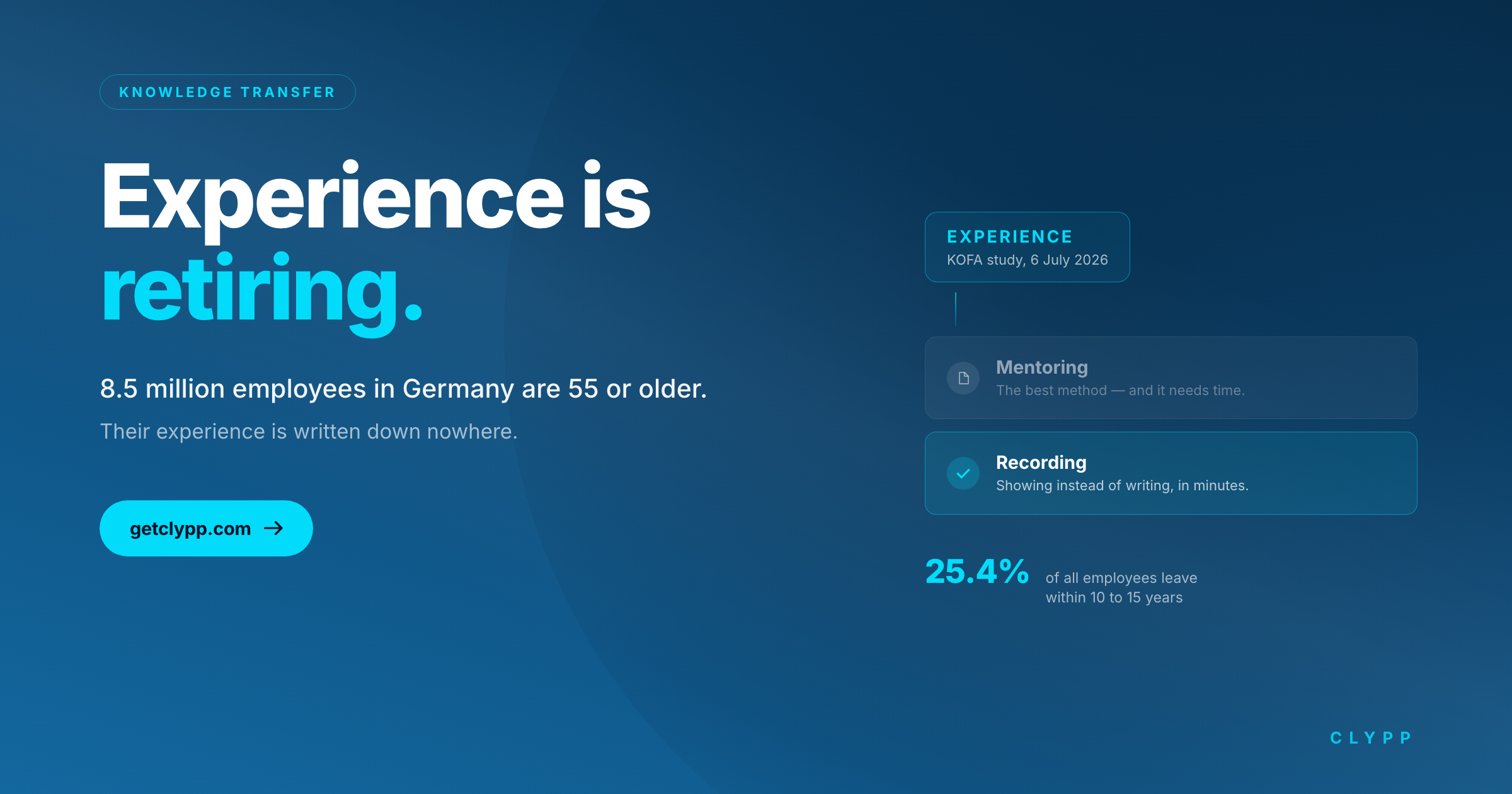
- 8.5 million employees in Germany are 55 or older. Roughly a quarter of the entire workforce will leave for age reasons within the next 10 to 15 years.
- The loss is qualitative, not just numerical. 4.6 million of those leaving work at skilled-worker level, 3.6 million in occupations already short of people.
- Mentoring is the best known method — and it is becoming unaffordable. Filling a vacancy took 70 days in 2010 and 95 days in 2023. The people who should be teaching are under pressure themselves.
- Translating work instructions does not solve the language problem. Over 27 percent of Germany's population has a migration background, and research considers plain translation of written instructions only partly effective.
- Experience can be shown even when it cannot be phrased. That is where recording instead of writing, and AI-assisted capture, come in.
Every plant has that one person. The setter who hears when a tool needs retightening. The maintenance technician who knows this line starts differently in winter. Nobody ever trained them in it, and they never wrote it down. They simply know.
And one day they work their last shift.
What happens next is often described most precisely by people in safety-critical work — air traffic control, for instance, where the gap between standard procedure and experience is unusually visible.
"You can train a lot of things. But some situations — a thunderstorm for example — require experience to know how to handle them, by exchanging knowledge with colleagues who have been through them before."
Damaris SchröderAir traffic controller and instructor at DFS Deutsche FlugsicherungSource: Deutsche Bank, "What business can learn from air traffic control about experience", September 2026It is not positions that leave, it is experience
The figures behind this became sharper in July 2026. The Skilled Labour Competence Centre at the German Economic Institute counted them: 8.5 million employees in Germany subject to social insurance contributions are 55 or older. That is 25.4 percent — a good quarter of the entire workforce, leaving for age reasons within the next 10 to 15 years.
What matters is not the headline number but its composition. 4.6 million of those employees work at skilled-worker level. 3.6 million work in occupations that are already short of people.
An earlier analysis put the gap in plain terms: around 4.5 million skilled workers are leaving, against roughly 3.2 million skilled workers under 30 coming in. That difference is no longer workforce planning. It is a structural break.
The loss is therefore qualitative as well as numerical. Someone who leaves after decades takes with them not just a position but the ability to resolve difficult situations quickly — situations that take inexperienced colleagues considerably longer.
Tacit experiential knowledge: why it resists being written down
Work science defines it concisely as knowledge "that employees are not fully aware of". The problem follows directly from that definition: they find it hard to put into words, let alone write down.
You cannot interview it out of someone, because the question cannot be asked. Anyone who has run the same line for thirty years no longer knows which parts need explaining. The knowledge has sunk into routine.
This is why learning by doing combined with mentoring is regarded as one of the few ways to transfer tacit knowledge at all — and often the only one available to new staff.
"There is invaluable implicit contextual knowledge."
Jörg BuxbaumGroup Leader Research & Foresight at DFS Deutsche FlugsicherungSource: Deutsche Bank, "What business can learn from air traffic control about experience", September 2026Mentoring works — but right now nobody has time for it
Here is the real contradiction, and it is rarely stated plainly.
The most effective known method of passing on experience requires two people spending time together: someone experienced who demonstrates, and someone inexperienced who follows along. That time is exactly what the labour shortage destroys.
Germany's Institute for Employment Research measured how long it takes to fill a vacancy: 70 days in 2010, 95 days in 2023. The vacancy overhang rate for qualified workers in western Germany recently stood at 45.6 percent — for almost every second opening, no suitably qualified person is regionally available.
The German Chambers of Commerce report that over 50 percent of surveyed companies struggle to fill positions, particularly in the industrial sector. In the metal and electrical industry, more than 110,000 skilled workers were missing in a single twelve-month period.
The result is a loop. The workforce shrinks, those remaining absorb more, and precisely because of that there is no time to train the newcomers meant to close the gap. The people who ought to be demonstrating have to produce instead.
Translating work instructions does not solve the language problem
A second finding has long been everyday reality on the shop floor. At the end of 2023, over 27 percent of Germany's population had a migration background, and companies name language gaps as the single most significant barrier to hiring — even for well-qualified specialists.
The obvious answer is to translate the work instructions. Research considers that insufficient:
"Plain translation of work instructions into another language is frequently associated with misunderstandings and errors in the work process and is only partly effective, so that new, innovative approaches to knowledge transfer are needed."
Nicole Ottersböck and Isabella Urbanifaa — Institute of Applied Industrial Engineering and Ergonomics, in: Wissensmanagement mit Künstlicher Intelligenz, Springer 2026Translated from GermanSource: ifaa-Edition, Springer, open access, 2026The reason is the same one that makes tacit knowledge hard to capture: a translated sentence carries the words, not the movement. Someone who has never seen how tight "hand-tight" is cannot read it up in any language.
What a publicly funded research project found
That this is not a niche problem is evident from the effort spent on it. Between August 2022 and January 2025, a consortium funded by Germany's Federal Ministry of Education and Research investigated exactly this question.
KI_eeper — Know how to keep
Goal: a digital, AI-based assistant that automatically captures expert knowledge at production workstations, stores it, and makes it available to inexperienced staff.
Participants: the ifaa, the Chair of Manufacturing Technology at the University of Duisburg-Essen, and two manufacturers as application partners — ESM Ennepetaler Schneid- und Mähtechnik and apra-norm Elektromechanik.
Funding: the BMBF programme "Zukunft der Arbeit", grant numbers 02L20C500–02L20C505. A paper from the project won the Best Paper Award at the International Conference on Applied Human Factors and Ergonomics in 2024. The results are published as an open access book.
The approach: sensor and video data from the running work process are analysed to detect patterns and infer the tacit experience behind them — without requiring the experienced person to articulate it.
"New technologies and AI can offer a more efficient solution in future and allow companies to secure know-how for the long term."
Nicole OttersböckResearch expert at the ifaa, at the project launch in September 2022Translated from GermanSource: ifaa press release "Babyboomer weg – Wissen weg?", 8 September 2022What is notable is the direction of travel. The technology is not meant to replace the knowledge but to take over the capture — the part where people fail, because they cannot say what they know.
"For the foreseeable future, people will remain central in day-to-day air traffic control. We do not see AI's greatest potential in the control room. Its greatest value lies in making knowledge visible, usable and permanently available."
Dr Gerolf ZiegenhainDirector Innovation & Planning at DFS Deutsche FlugsicherungSource: Deutsche Bank, "What business can learn from air traffic control about experience", September 2026Four things that make knowledge transfer possible at all
From the evidence, a picture emerges of what makes knowledge retention fail in production — and what carries it.
It starts years before retirement. The KOFA study explicitly recommends planning tandems, mentoring and structured handovers so that experience is not passed on only shortly before someone leaves. Starting in the final quarter is starting too late.
It costs the experienced person as little time as possible. Any method that demands two hours of writing will not be used — not out of unwillingness, but because the time genuinely is not there. Recording what is being done anyway is the only form of capture that does not worsen the bottleneck.
It shows rather than describes. What cannot be phrased can be demonstrated. That is why video-based formats carry tacit knowledge better than prose — and why they work across language barriers where translated documents fail.
It ends up where people look. Captured knowledge that lands on a shared drive is as lost as the unwritten kind. It belongs in the knowledge base, the intranet or at the workstation itself — findable at the moment the question arises.
Put together, this leads to the same conclusion as the new ISO 9001:2026 does for process documentation: what counts is not that something was documented, but that it lands.
Frequently asked questions about knowledge transfer in production
What is experiential knowledge?
Experiential knowledge is the capability that grows out of repeated practice and goes beyond subject expertise. It shows up above all in difficult situations: experienced people resolve them quickly, inexperienced people take considerably longer. A large part of it is tacit — not fully conscious even to the person who holds it.
Why is writing processes down not enough?
Because the decisive part usually cannot be written down. Someone who has performed a task for years no longer knows which details need explaining. Documentation captures the steps, not the judgement in between.
When should a company start transferring knowledge?
Well before retirement. Labour market research recommends planning handovers structurally rather than triggering them by event. In practice that means several years of lead time for key positions, not several weeks.
Which methods demonstrably work?
Learning by doing combined with mentoring and age-mixed teams is regarded as the most effective route for tacit knowledge. The limitation is not the method but its availability: it consumes the time of experienced staff, which is scarce in a labour shortage.
Can AI preserve experiential knowledge?
Not replace it, but help capture it. Research projects such as KI_eeper pursue the approach of detecting patterns in the running work process automatically, instead of asking employees for a description they cannot supply. The decision stays with the human.
What helps with a workforce of many mother tongues?
Formats that show rather than describe, and translation in addition to the image rather than instead of it. Plain text translation of work instructions is considered only partly effective and error-prone in research.
How do you measure whether knowledge transfer is working?
By onboarding time, by the error rate in the first months, by the number of questions still routed to individual knowledge holders — and by whether documented content actually gets opened. Usage data is the most honest indicator.
About Clypp
Clypp is a software platform from Germany that lets employees record their own workflows and turns those recordings automatically into structured guides — with steps, screenshots, voice-over and translations. Recording takes minutes; the experienced person demonstrates instead of writing.
The result can be exported as video, PDF or SCORM package and embedded in Microsoft Teams, an LMS or a wiki. Data is stored exclusively on EU servers; Clypp is ISO 27001 certified and GDPR compliant.
The experts quoted
Nicole Ottersböck
Research expert at the ifaa — Institute of Applied Industrial Engineering and Ergonomics
Ottersböck is a social scientist and has been with the ifaa in Düsseldorf since 2016. She led the work-science side of the BMBF project KI_eeper and co-edited the concluding volume, "Wissensmanagement mit Künstlicher Intelligenz".
Damaris Schröder
Air traffic controller and instructor at DFS Deutsche Flugsicherung
Schröder has been an air traffic controller since 2017 and mentors trainees both in the control room and in the simulator. Her job is explicitly to pass on experience from daily operations — the very thing most companies have no time for.
Jörg Buxbaum
Group Leader Research & Foresight at DFS Deutsche Flugsicherung
Buxbaum holds a degree in aerospace engineering and has worked at DFS since 1999. He researches how automation and artificial intelligence can support people in safety-critical systems, and how experiential knowledge is transferred.
Dr Gerolf Ziegenhain
Director Innovation & Planning at DFS Deutsche Flugsicherung
A physicist by training, Ziegenhain has held various leadership roles at DFS since 2010 and drives topics such as automation, knowledge management and the future of critical infrastructure.
Sources
- Jurek Tiedemann, Franziska Arndt, KOFA Study 4/2026, "Wertvolle Erfahrung sichern", German Economic Institute, 6 July 2026.
- Nicole Ottersböck, Isabella Urban, "Trends und Entwicklungen in der Arbeitswelt", in: Wissensmanagement mit Künstlicher Intelligenz, ifaa-Edition, Springer 2026, open access. Source of the IAB, DIHK and Destatis figures cited here.
- ifaa, press release "Babyboomer weg – Wissen weg?", 8 September 2022.
- ifaa, KI_eeper project page, accessed 22 September 2026.
- Deutsche Bank, "What business can learn from air traffic control about experience", What Next, September 2026. Source of the DFS quotations.
- Further reading: AI SETTA on knowledge loss and the retirement wave and data unplugged on knowledge management in the Mittelstand, both in German.
Published 22 September 2026. All quotations were verified against the original source on the day of publication. Quotations marked as translated were given in German in the original.

