
The five things that matter
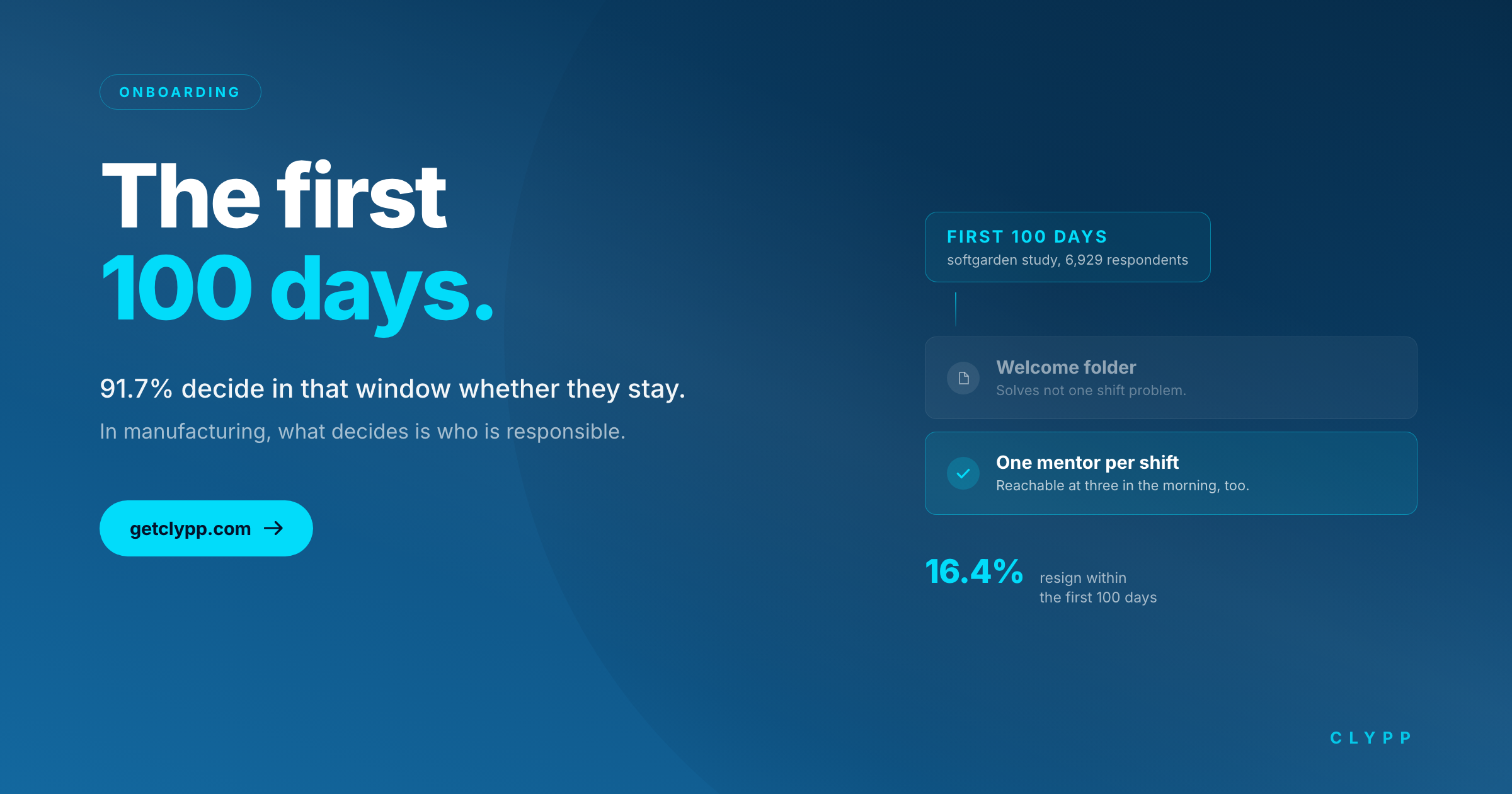
- The decision is made in the first 100 days. 91.7 percent of respondents say they recognise in that window whether the job and the employer fit. 16.4 percent resigned within it.
- The most common reason for leaving is a broken expectation. 67.8 percent name the gap between what was promised and what they found.
- Feedback is the largest unused lever. 68.4 percent want regular feedback during onboarding; only 26.4 percent get it.
- Manufacturing plays by different rules. Shift work, safety briefings, language barriers and knowledge you can only pick up by watching — no welcome folder solves any of it.
- A workable model needs one mentor per shift. Not one per person. Otherwise whoever starts on nights has nobody.
A first day in manufacturing rarely begins at a desk. It begins with safety boots, a briefing and the noise of a hall where everyone else already knows what they are doing. There is no introduction week with coffee and slides. There is a shift, and it is running.
And there is one person who is new and does not know whom they are allowed to ask.
How much gets decided in those weeks is underestimated by most plants.
"In many companies onboarding is still an organisational process, not a real dialogue."
Madeline TimmerMarketing Director at softgardenTranslated from GermanSource: SAATKORN, interview on the softgarden onboarding study, 31 October 2025The decision is made in the first 100 days
An online survey of 6,929 verified applicants produces an unusually clear number: 91.7 percent say they recognise within the first 100 days whether the job and the employer are a long-term fit.
The verdict therefore arrives long before the probation period ends — and it is final. 16.4 percent of respondents actually resigned within that window.
The most frequently cited reason is neither conflict nor pay. It is a broken expectation: 67.8 percent name the discrepancy between what was promised during hiring and what they found once inside.
For manufacturing that carries an uncomfortable implication. Advertise a modern plant and a strong team, then let the new hire trail around for two weeks without a named contact, and the promise has been broken — even if nobody calls it that.
Early attrition: the departure that costs twice
Early attrition is the loss of new employees within their first months — usually during or shortly after probation.
It is more expensive than later turnover because the company has already spent everything: selection, contract, safety briefing, training time from experienced colleagues — and has received nothing back. Afterwards the position is not merely open again; the entire effort has been burned once.
Particularly painful in manufacturing: that training time also consumed the hours of experienced staff, which are scarce to begin with.
Manufacturing plays by different rules than the office
Almost everything written about onboarding assumes desk work. Welcome email, laptop on day one, calendar invitations for introductions. On a shop floor, little of it applies.
Four differences shape the reality.
Shift work fragments the support. Whoever showed the new hire something on Monday is on nights by Wednesday. A single mentor is not enough.
Safety is non-negotiable and comes first. The briefing is mandatory before anything can be learned — and it delivers a flood of information on the day with the lowest capacity to absorb it.
Language is part of the equation. On many teams the instruction is not given in the listener's mother tongue. A misunderstanding here does not cost a revision loop; it costs scrap or an injury.
The decisive part cannot be explained. How tight a bolt sits, when a machine sounds different from usual — that is knowledge which only transfers by watching. We covered it at length elsewhere: it is the same tacit experience that retires with the baby boomers.
How one German plant solved it
Rather than reason it through in the abstract, it is worth looking at a model that grew inside a running three-shift operation.
The mentor model at SEALABLE Solutions
SEALABLE Solutions in Waltershausen, Thuringia, has been making sealing technology for roughly 200 years and runs three shifts. The plant structured its onboarding into seven steps:
- Welcome, safety briefing, introduction to the team
- The onboarding plan is walked through together with the new person — not handed over
- The first two weeks on early shift only, to practise the routines
- Then assignment to the regular shift — with a dedicated mentor per shift
- After roughly one month, a documented assessment conversation
- After roughly two months, a second one
- After roughly six months, the closing conversation
The clever part sits in steps three and four. Two weeks of early shift only is operationally inconvenient, but it solves the supervision problem: during that time somebody is always there. And a mentor per shift means the new person has someone at three in the morning, too.
"An experienced mentor can give valuable insight into the workflows, the company culture and specific areas of responsibility."
Anika Bessing-SchmidtHuman Relations Manager at SEALABLE SolutionsTranslated from GermanSource: ThAFF InnoNET, field report "Onboarding in der Produktion"More revealing than the management view is the feedback from the floor:
"From day one I had a direct contact person, not only for the production process but also for social matters within the company."
Production employee at SEALABLE SolutionsNot named in the field reportTranslated from GermanSource: ThAFF InnoNET, field report "Onboarding in der Produktion""Not only for the production process" — that half-sentence is the actual finding. What stays with people is not the briefing. It is that somebody was responsible.
The largest unused lever is feedback
Looking for the biggest gap in the survey, you do not find it in equipment or tooling. You find it in conversation.
68.4 percent of respondents want regular feedback during onboarding. 26.4 percent receive it. The space between those two numbers is the cheapest and least used instrument in people management.
That relationships carry the process, not systems, shows up elsewhere in the same survey: 74.7 percent name colleagues as their most important support, 57.7 percent buddies or mentors. No portal, no handbook.
"Whoever disappoints in the first 100 days loses talent — often for good."
Madeline TimmerMarketing Director at softgardenTranslated from GermanSource: SAATKORN, interview on the softgarden onboarding study, 31 October 2025Five things that make onboarding in manufacturing hold up
From the evidence and the case in practice, a pattern emerges.
Responsibility before material. One named person per shift does more than any folder. The question "whom may I ask?" has to be answered on day one.
Align the promise with the reality. If two thirds leave over disappointed expectations, the lever sits in the job advert. Better to describe the shift pattern honestly than to explain it away on day one.
Put feedback dates in the calendar. After one month, after two, after six — as in the Thuringian model. What is scheduled happens.
Show rather than describe, and make it repeatable. A mentor can demonstrate a movement three times, not thirty. What has been recorded once is available on the night shift too — and in the language that is needed.
Separate the repeatable from the personal. Safety briefings, machine operation and standard routines belong in a documented form that can be called up at any time. The mentor's hours then go to what only they can give: context, culture, responsibility.
Frequently asked questions about onboarding in manufacturing
How long does onboarding in manufacturing take?
Formal training at a single workstation is often complete within weeks; genuine integration takes longer. The Thuringian model schedules assessment conversations after one, two and six months — six months is therefore a workable frame for the whole process.
What makes manufacturing onboarding different from office onboarding?
Four things: shift work that fragments supervision; the safety briefing that delays everything else; language barriers on mixed teams; and the high share of knowledge that transfers only by watching.
Why do new employees leave so early?
Most often because reality does not match what was conveyed during hiring — 67.8 percent of respondents name exactly that. Missing supervision and absent feedback amplify the effect.
How many mentors does a shift operation need?
One per shift the new person is assigned to. A single contact only works while both are on the same shift, which is rarely the case in three-shift operations.
What belongs in an onboarding plan for manufacturing?
The safety briefing, the sequence of workstations, named mentors per shift, fixed dates for assessment conversations, and a list of the routines to be mastered independently. What matters is that the plan is discussed together rather than merely handed over.
How do you handle language barriers?
With formats that show rather than describe, and with translation in addition to the image rather than instead of it. Plain text translation of work instructions is considered error-prone and only partly effective in research.
How do you measure whether onboarding works?
By early attrition over the first six months, by time to independent work at the station, by the error and scrap rate of the first weeks — and by whether the agreed conversations actually took place.
About Clypp
Clypp is a software platform from Germany that lets employees record their own workflows and turns those recordings automatically into structured guides — with steps, screenshots, voice-over and translations. For onboarding that means the mentor demonstrates once and the recording demonstrates as often as needed — on the night shift too, and in the language required.
The result can be exported as video, PDF or SCORM package and embedded in Microsoft Teams, an LMS or a wiki. Data is stored exclusively on EU servers; Clypp is ISO 27001 certified and GDPR compliant.
The voices quoted
Anika Bessing-Schmidt
Human Relations Manager at SEALABLE Solutions, Waltershausen
Bessing-Schmidt runs people operations at a sealing technology manufacturer with roughly 200 years of history and three-shift production. The mentor model described here comes from the running operation, not from a drawing board.
Madeline Timmer
Marketing Director at softgarden
Timmer leads marketing at the Berlin recruiting provider softgarden and presents its onboarding study. Her statements are those of a vendor in the field — the underlying survey of 6,929 applicants should be judged on its own terms.
Sources
- ThAFF InnoNET, field report "Onboarding in der Produktion" with Anika Bessing-Schmidt, SEALABLE Solutions. In German.
- ThAFF InnoNET, method description "Onboarding in der Produktion" — source of the seven-step model. In German.
- SAATKORN, interview with Madeline Timmer on the softgarden onboarding study, 31 October 2025. Source of the quotations and figures; survey of 6,929 verified applicants. In German.
- softgarden, study page "Erfolgreiches Onboarding". The full methodology sits behind a download form.
Published 22 September 2026. All quotations were verified against the original source on the day of publication. Quotations marked as translated were given in German in the original.

