
The five things that matter
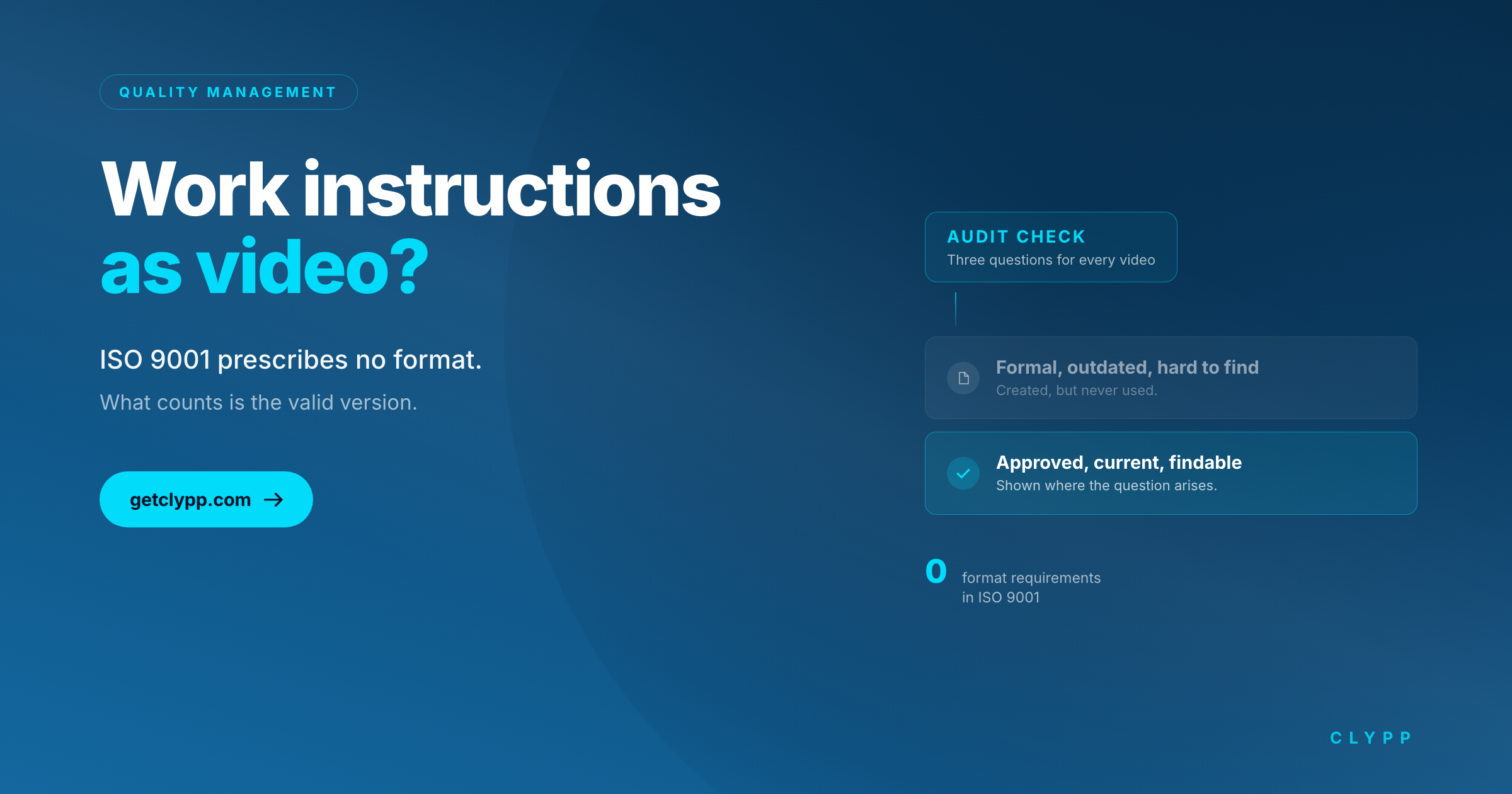
- ISO 9001 prescribes no format. Work instructions can be text, graphics or video, including a phone recording made at the workstation.
- What counts is the valid version. Employees must always work with the correct document, whatever the medium.
- Most work instructions fail in daily use, not in the audit. Too formal, outdated, hard to find: whatever is created but not used is waste.
- On the shop floor, management cannot document alone. The people who know the equipment have to contribute. A recording lowers the barrier.
- An audit looks at approval, status and findability. These three questions apply to a video just as they do to a PDF.
Few documents in quality management have a reputation as poor as the work instruction. It is seen as formal, tedious to maintain and written more for the auditor than for the people at the machine. Meanwhile, the most obvious way to show how something is done sits in every jacket pocket: the phone camera.
That raises a practical question for quality managers: can a work instruction be a video, and if so, how does it hold up in an audit?
The standard prescribes no format
The short answer is yes. Stephan Joseph, a quality management consultant who prepares companies for ISO 9001 certification, puts it plainly in his article "Die Arbeitsanweisung" (in German):
"ISO 9001 prescribes no medium or format. Useful work instructions should therefore be provided in a form that employees can find and use quickly. That can also mean videos (screen recordings, phone recordings, …)."
Stephan JosephConsultant, trainer and author, Joseph BeratungTranslated from GermanSource: Joseph Beratung, "Die Arbeitsanweisung"The consultancy Büro-Kaizen's guide to process documentation (in German) reaches the same conclusion: the standard prescribes "no specific type or method of documentation", and a process description can be written or graphical. Which form fits depends on the case.
What the standard does require is a purpose. Mr Joseph quotes clause 4.4.2 of ISO 9001:2015: the organisation shall maintain documented information "to the extent necessary to support the operation of its processes". Support is the key word. An instruction nobody opens supports nothing.
Why work instructions fail in daily use
Mr Joseph names five reasons for the work instruction's bad reputation: an off-putting formal structure, technical terms instead of the language people actually use, outdated content that never absorbs feedback, poor findability and the formal check in the audit.
None of these reasons has anything to do with the medium. A video can be just as outdated and hard to find as a PDF. But it lowers two barriers where written instructions fail most often: it shows the movement instead of describing it in standards language, and it is made where the work happens.
"Ultimately: anything that is created but not used is waste. And waste does not speak for meaningful quality."
Stephan JosephConsultant, trainer and author, Joseph BeratungTranslated from GermanSource: Joseph Beratung, "Die Arbeitsanweisung"Who writes the instruction and who should
Büro-Kaizen points to a limit that production companies reach quickly: in halls with production lines, management can no longer create the process documentation entirely on its own. Machine builders and engineers have to contribute their technical part.
This is exactly where things stall in practice. The people who know the equipment best rarely have time to fill in templates. A recording, by contrast, takes little more time than the task itself. The person who has mastered the movement becomes the person who documents it, without a detour through someone who can only describe it.
"What use is good process documentation if nobody looks at it to draw conclusions and improve the processes? Or to derive their own tasks from it?"
Büro-KaizenGuide to process documentationTranslated from GermanSource: Büro-Kaizen, "Prozessdokumentation: Aufbau, Inhalte, Tools & Video-Anleitung!"Tools such as Clypp are designed for exactly this route: the task is recorded while it is being carried out anyway, and the result is a video with a written sequence of steps and a voice-over. When the process changes, the affected step is recorded again instead of revising a document. Whether that holds up in an audit, however, depends not on the tool but on the document control behind it.
What counts in an audit: three questions for every video work instruction
The standard leaves the medium open, but not the control. Mr Joseph sums up the requirement in one sentence: it must be ensured "that employees always work with the correct documents". For a video, that means in practice:
Three questions an auditor may ask
Is the version approved? Who reviewed the video and released it for use, and can that be traced?
Is it current? When the process changes, the recording has to be replaced, and the old version must no longer be in circulation.
Can it be found? The instruction has to be available where the question arises: at the workstation, not only in the quality manual.
Büro-Kaizen describes where this should lead: changes have to be documented again, because "in this way the process documentation itself becomes a living process". With video, this can be an advantage. Instead of revising a document, the changed step is simply recorded again.
What content a work instruction needs in principle and what the new ISO 9001:2026 changes for process documentation are covered in separate articles.
Frequently asked questions about video work instructions
Is a video work instruction permitted under ISO 9001?
Yes. The standard prescribes neither medium nor format. What matters is that the documented information supports the operation of the processes and that people work with the valid version.
Do we also need a written version?
The standard does not require one. A short text can still be useful, for example for inspection characteristics, limit values or safety notes that people need to be able to look up. A combination of video and short text is often the most practical solution.
How does a video become controlled information?
Through the same rules as any document: traceable approval, a clearly identified version with its status, a responsible person and a repository from which outdated versions disappear.
Who should create video work instructions?
The person who has best mastered the task. Quality management and line supervisors review and approve. The recording itself should not sit with someone who can only describe the movement.
How often does a video work instruction need updating?
Whenever the process changes. A fixed review date helps catch gradual deviations before they come up in an audit.
The standard asks for effect, not form: instructions that are found, understood and kept current. That is most likely to happen when the instruction is made where the work happens and maintaining it takes no more effort than the task itself. That is what Clypp is built for.
A work instruction nobody opens won't pass an audit.
The standard allows any format, but it asks about effect. With Clypp, the person who has mastered a task records it once. The result is a video instruction with a written sequence of steps, available where the question arises and recorded again, not revised, when the process changes.
- Recorded at the machine: by the person who has mastered the step.
- Shown, not phrased: in 100+ languages on request, without a second shoot.
- Embeddable in Teams, an LMS or a wiki: where the question arises.
Clypp is a software platform from Germany for video work instructions. In use at RATIONAL, Rosenberger and Elementar, among others.
The experts quoted
Stephan Joseph
Consultant, trainer and author, Joseph Beratung
A graduate engineer, Stephan Joseph guides companies to ISO 9001 certification and builds quality management systems on SharePoint and Microsoft 365. He is the author of "Wieso ISO? Über Sinn und Unsinn bei Zertifizierungen nach ISO 9001 und co." (2017) and has offered online quality management courses through the Lev-Akademie since 2020.
Büro-Kaizen
Consultancy for office and process organisation
Büro-Kaizen was founded by Jürgen Kurz and has stood for office efficiency for around 25 years. Kurz is the author of books including "So geht Büro heute!".
Sources
- Stephan Joseph, Joseph Beratung, "Die Arbeitsanweisung" (in German), 21 December 2022, updated 2 December 2023. Contains the quotation from ISO 9001:2015, clause 4.4.2.
- Büro-Kaizen, "Prozessdokumentation: Aufbau, Inhalte, Tools & Video-Anleitung!" (in German), 27 August 2024, updated 14 July 2026.
Draft, as of 29 September 2026. All quotations were verified against the original source. Quotations marked as translated were given in German in the original.

