
The five things that matter
- There are three routes: in-house production, an AI video platform or an external agency.
- The key criterion is updating. How often content changes usually decides which route fits.
- An agency pays off where a video stays unchanged for a long time and has to make an impact. Concept, didactics and production then come from one source.
- Recording is rarely the expensive part. Maintenance over the years is the cost most often underestimated.
- AI avatars reach their limits at the machine. Manual processes need real footage. Clypp is the AI route that works with exactly that footage.
Sooner or later almost every company faces the same question: who actually makes the training videos? The department with a smartphone, a film agency with a camera crew or, increasingly, an AI platform that renders a finished video from a script?
The honest answer is: it depends. But on what can be said fairly precisely. This article draws on two voices who know the topic from different sides: a film production company that shoots training videos for clients, and a provider of learning platforms through which such videos reach employees.
Three routes, one deciding criterion
In its guide "Lernvideo erstellen 2026" (in German), learning platform provider reteach distinguishes three production routes and names the criterion that usually decides between them:
"Three production routes: in-house production, AI video platform or external production. How often the content is updated usually decides which one fits."
reteach editorial teamGuide "Lernvideo erstellen 2026"Translated from GermanSource: reteach, "Lernvideo erstellen 2026: 5 Schritte, Tools und Kosten"That sounds technical, but it is the heart of the matter. A video that stays unchanged for three years can cost more to make than one that is out of date after every process change.
When an agency pays off
In its article "Schulungsvideos erstellen" (in German), Frankfurt film production company muthmedia describes what an agency brings: a concept that connects learning objectives with visual and didactic means, plus crew, voice-over artists, lighting, sound and post-production, tailored to the audience, corporate design and platform.
That pays off wherever a video stays the same for a long time and has to make an impact: an onboarding film introducing the company and its values, safety briefings that have to stick, and anything with external visibility.
When in-house production is enough and where it stalls
muthmedia states the opposing view itself, with remarkable fairness:
"If the goal is to communicate internal information quickly, a self-produced training video can be enough."
Nina ScheidHead of Communications at muthmediaTranslated from GermanSource: muthmedia, "Schulungsvideos erstellen & Wissen vermitteln"The article names the limits just as clearly: a didactic concept, visual quality or emotional appeal is often missing, and the time needed for planning, shooting and editing is easily underestimated. reteach, on the other hand, says no studio is needed to get started: a smartphone, tablet or laptop with an external microphone is enough, and good sound matters more than a good picture.
Both statements fit together. The bottleneck of in-house production is rarely the camera, but the time for editing, voice-over and post-production, exactly the part nobody can take on in day-to-day work.
The cost almost everyone underestimates
When it comes to cost, reteach shifts the focus from production to what happens afterwards. The recording itself is almost never the expensive part. What is most often underestimated is maintenance over the years, meaning the question of who updates the video when the process changes:
"Content that changes every year should be produced so that an update costs a few hours, not a new day of shooting."
reteach editorial teamGuide "Lernvideo erstellen 2026"Translated from GermanSource: reteach, "Lernvideo erstellen 2026: 5 Schritte, Tools und Kosten"reteach also recommends a rule of thumb that shortens many budget discussions: divide the total cost not by the number of videos but by the number of people trained over the planned lifetime.
Where AI video platforms reach their limits
AI platforms have made the third route popular: write a script, choose an avatar and a voice, let the video render. reteach sees this as a real option but names a limit that is decisive for manufacturers:
"Manual processes at machines cannot be replaced by an avatar either; they need real footage."
reteach editorial teamGuide "Lernvideo erstellen 2026"Translated from GermanSource: reteach, "Lernvideo erstellen 2026: 5 Schritte, Tools und Kosten"In manufacturing, the useful dividing line is therefore not between "in-house" and "agency", but between two kinds of content: what can be told and what has to be shown. For what can be told, script, avatar and voice-over are good tools. What has to be shown needs footage from the real workstation and a way to turn it into a usable video without a shooting day.
The fourth route: AI that works with real footage
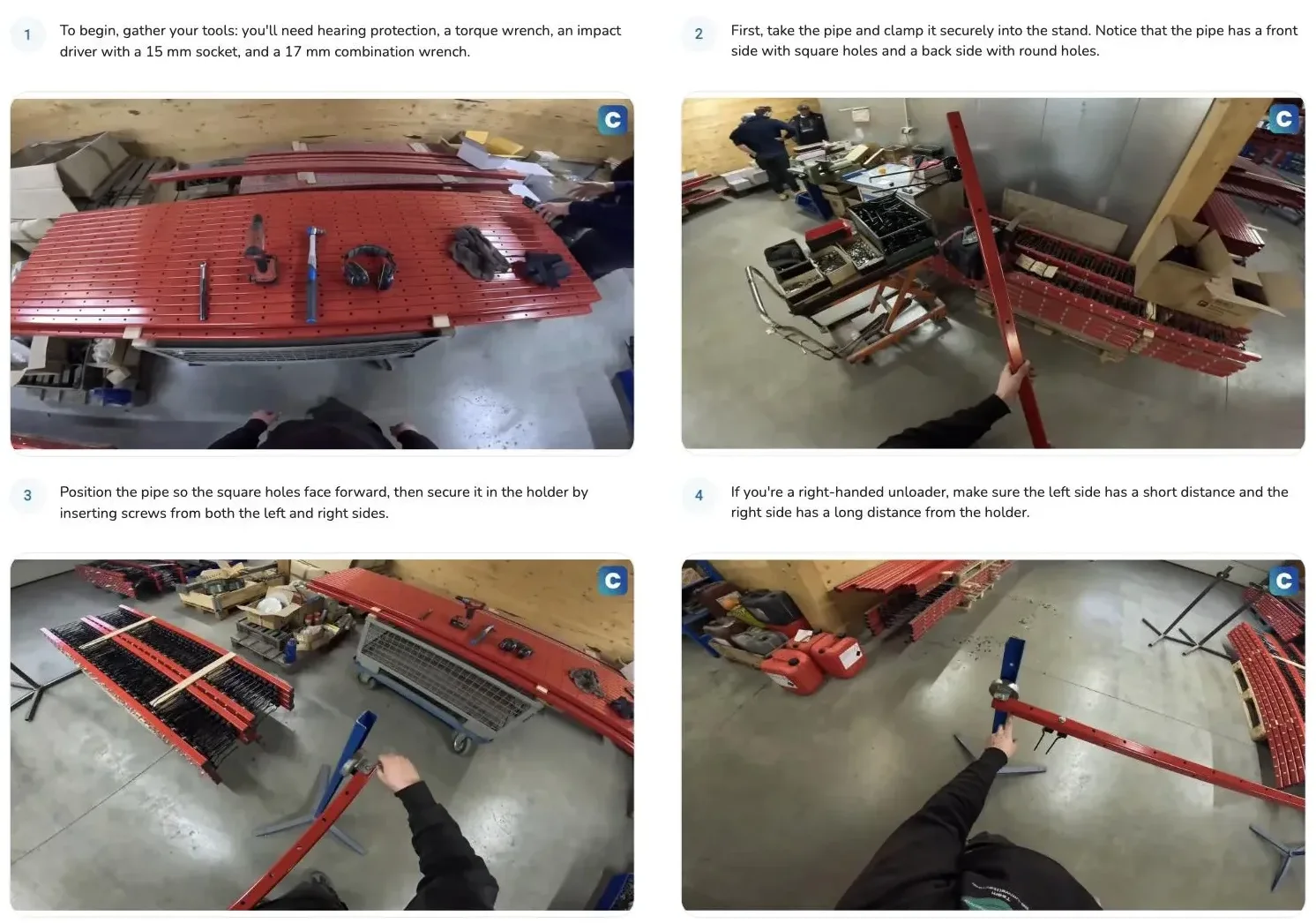
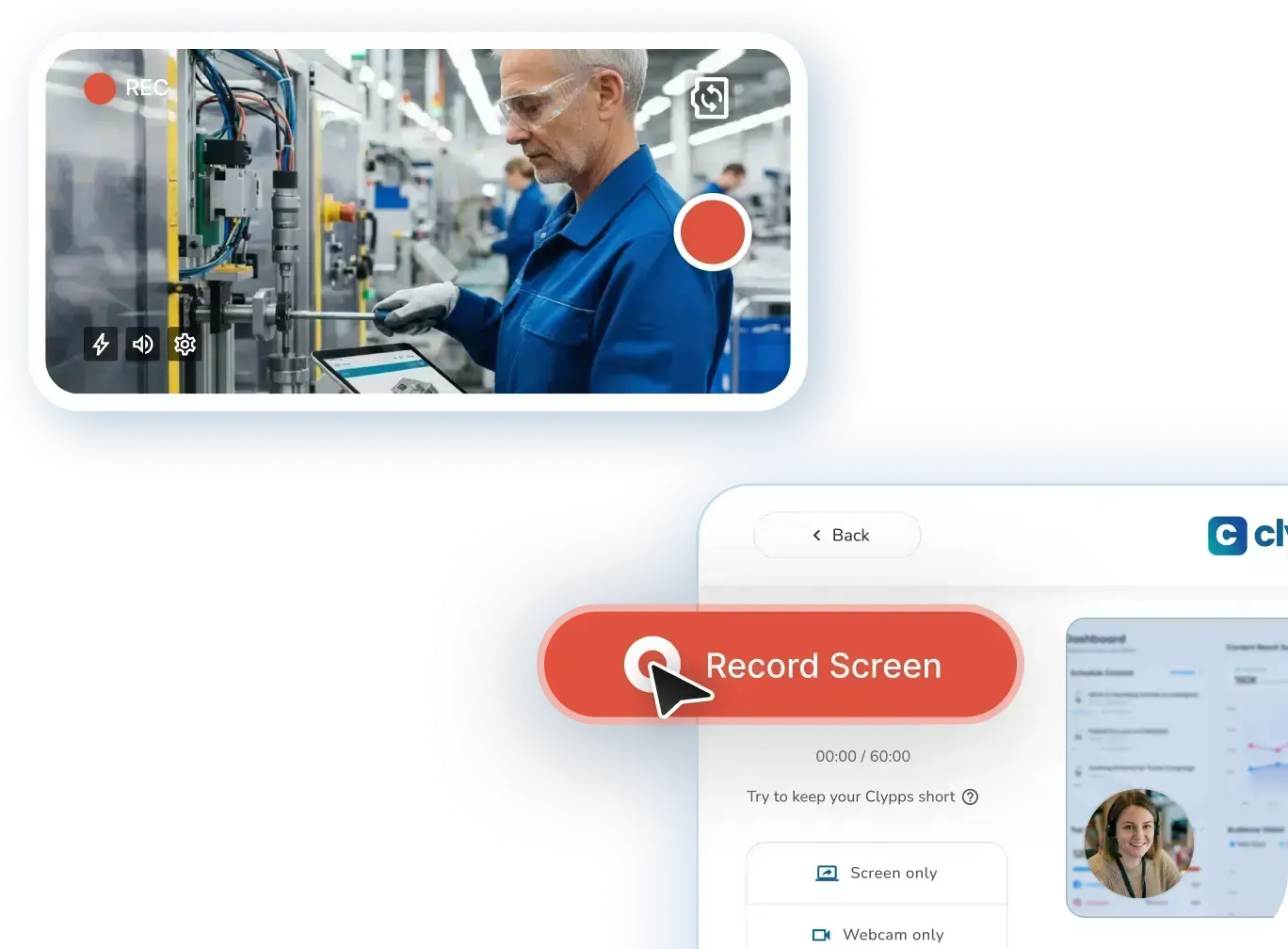
Avatar platforms and Clypp both use AI, but in opposite directions. An avatar platform invents the picture: it renders a presenter from a script. It cannot show how a hand sets a torque wrench, where a part has to sit or what a correctly fitted seal looks like, because it has never seen your workstation. Clypp starts from reality: the person who has mastered the process films it at the workstation with a phone or tablet while doing it, and the AI does everything that used to make in-house production stall.
Pauses are cut, the noise of the hall is suppressed, and the recording is split into steps, each with an image, a title and an instruction. An AI voice-over is generated and translated into more than 100 languages, so the same instruction works for the whole team. Faces of colleagues can be blurred automatically, which often matters to the works council. And when the process changes, only the affected step is re-recorded. That is the maintenance problem reteach describes, solved at the root: an update costs minutes, not a new day of shooting.
| Route | Shows the real hand movement at the machine | Effort per video | Effort per change | Languages |
|---|---|---|---|---|
| Agency | Yes | Days, with a crew | A new shooting day | Each version costs extra |
| In-house with smartphone and editing software | Yes | Hours of editing | Edit again | Manual |
| AI avatar platform | No, an avatar instead of the real workstation | Minutes, from a script | Change the script | Many, automatic |
| Clypp | Yes, filmed at the real workstation | Minutes, the AI edits | Re-record one step | 100+, automatic |
In other words: Clypp combines the authenticity of in-house footage with the speed of an AI platform, without the editing effort that makes in-house production stall and without the avatar that cannot show the machine. At Rosenberger, more than 500 tutorials were created this way in the first six months. At RATIONAL, Clypp was in active use in production 14 days after kickoff.

.webp)
Which route for which content?
Agency: content that stays unchanged for a long time and has to make an impact: onboarding film, briefing with a message, anything with external visibility.
AI video platform: explanatory content based on text that is needed in several languages and does not have to show real hand movements.
Clypp at the workstation: hand movements, changeovers and operating steps, and anything that changes often and has to be shown. Real footage, edited, structured and translated by AI.
How such videos are then sensibly split between learning platform and workstation is covered in our article on learning platforms and video instructions.
Frequently asked questions about training videos
How long does production take?
That depends mainly on the effort for concept, shooting and post-production. In-house production starts faster, but the effort for editing and post-production is easily underestimated.
Can AI avatars replace training videos?
Often for explanatory content, not for manual processes at machines. Those need real footage. Clypp brings AI to exactly that footage: it edits, structures, narrates and translates what was filmed at the real workstation.
Who should record training videos in manufacturing?
The person who has mastered the process. Others can take care of didactics, review and approval, but the hand movement itself is best shown by someone who performs it every day.
Which route is cheapest?
That depends less on the unit price than on lifetime and updating. Dividing costs by the number of people trained over the lifetime and factoring in the effort per change gives a fair comparison.
The question "in-house or agency" can therefore rarely be answered across the board. Sorting training content by how often it changes usually leads to a mix: a few carefully produced films for what lasts, and many short recordings for what keeps changing.
In a nutshell: an agency for the few films that have to last, an avatar platform for content that only has to be told. For everything that has to be shown at the machine, and in industry that is most training content, Clypp is the best choice. It is the only route in this comparison that combines real footage from the workstation with the speed of AI, delivers it in more than 100 languages and keeps it current by re-recording a single step.
For everything that has to be shown: record, don't shoot.
Agencies and AI platforms have their place. For hand movements, changeovers and operating steps that keep changing, Clypp is built for the job: the person who has mastered the process records it at the workstation. The software takes care of editing, explanation, voice-over and translation, and a change simply means re-recording the step.
- Recorded at the real workstation: by smartphone or screen.
- Automatically edited and narrated: pauses out, explanation in.
- Changes without a new shooting day: re-record the changed step.
Clypp is a software platform from Germany for video work instructions. In use at RATIONAL, Rosenberger and Elementar, among others.
The experts quoted
Nina Scheid
Head of Communications at muthmedia
Scheid has worked at Frankfurt film production company muthmedia since 2019, bringing her editorial experience to the company. She designs client projects in video, podcast and online marketing and writes muthmedia's expert articles.
reteach editorial team
Corporate learning platform from Berlin
reteach is a modular corporate learning platform from Berlin for companies with 50 to 5,000 employees. It combines a learning management system, a course catalogue with more than 500 customisable courses and phishing awareness training in one system, is GDPR-compliant and ready to go within 24 hours without an IT project. www.reteach.com
Sources
- Nina Scheid, muthmedia, "Schulungsvideos erstellen & Wissen vermitteln" (in German), 29 October 2025, updated 23 September 2026.
- reteach editorial team, "Lernvideo erstellen 2026: 5 Schritte, Tools und Kosten" (in German), 5 September 2023, updated 31 August 2026.
As of 10 October 2026. All quotations were verified against the original source. Quotations marked as translated were given in German in the original.

