
The five things that matter
- Understandable is mandatory, the native language is not. Briefings and operating instructions must be given in a form and language the employees understand.
- Self-study documents are not enough. Pictures and videos may support, but they do not replace the conversation.
- A one-to-one translation helps only so far. Plain language and pictures from your own operation work better.
- Demonstrating beats reading out. And something is only understood when employees can show it correctly themselves.
- Briefings in one's own language change participation, as the experience of AST Arbeitssicherheit shows.
Many production and logistics operations employ people who speak little or no German. For occupational safety this is not a side issue. A safety briefing that was not understood has formally taken place and practically has not.
This article draws on two voices: the article by Dr. Hannes Patzke in BGN Akzente, the magazine of the German statutory accident insurer for the food and catering industry, and the experience of AST Arbeitssicherheit, an engineering office and training centre for occupational health and safety that also gives briefings in employees' native languages.
What German occupational safety law requires
Under Section 12 of the German Occupational Safety and Health Act, employers must brief employees sufficiently and appropriately, with instructions and explanations tailored specifically to their workplace. Section 14 of the German Hazardous Substances Ordinance explicitly requires operating instructions to be made available "in a form and language understandable to the employees".
Patzke puts this into context in "Trotz Sprachbarrieren sicher arbeiten" (in German): briefings and operating instructions do not necessarily have to be in the native language, but they must be understandable. Where pronounced communication problems can lead to a hazard, he writes, this is to be regarded as insufficient qualification within the meaning of Section 5 of the Occupational Safety and Health Act, and so part of the risk assessment. On the means, he writes:
"If verbal communication is not sufficiently possible, other media such as pictures and videos can be used for support. What is not sufficient, on the other hand, is merely handing those affected documents for self-study."
Dr. Hannes PatzkeAuthor in BGN Akzente, the magazine of the German Social Accident Insurance Institution for the Foodstuffs and Catering Industry (BGN)Translated from GermanSource: BGN Akzente, „Trotz Sprachbarrieren sicher arbeiten“How serious the consequences can be is shown by the example the article opens with: a new employee understands an instruction to inspect a silo from the outside only as an instruction to clean it, climbs in and is caught by the screw conveyor.
Why translation alone is not enough
Translation apps and AI have lowered the barrier considerably. Patzke explicitly describes this as progress, but warns at the same time:
"A quick one-to-one translation, however, does not necessarily benefit occupational safety."
Dr. Hannes PatzkeAuthor in BGN Akzente, the magazine of the German Social Accident Insurance Institution for the Foodstuffs and Catering Industry (BGN)Translated from GermanSource: BGN Akzente, „Trotz Sprachbarrieren sicher arbeiten“More effective, in his account, is an operating instruction with pictures from one's own operation and a few short sentences in plain language. Plain language also improves the quality of machine translation: no technical terms unless necessary, no long compound nouns, consistent terminology. The Austrian Economic Chamber reaches the same order in its article "Mehrsprachige Teams mit KI im Arbeitsalltag unterstützen" (in German): simplify first, then translate, then check the key details. For safety briefings, according to the chamber, an AI translation replaces neither the briefing nor the duty to make sure it was understood.
What a briefing in one's own language changes
In "Arbeitsschutz kennt keine Grenzen" (in German), AST Arbeitssicherheit describes the work of its safety engineer Nenad Gocevski, who gives briefings to workforces from Serbia, Croatia and Bosnia-Herzegovina in their language. His starting point:
"On construction sites, the different languages are often a major obstacle, especially with employees from countries where occupational safety is not as firmly established as in Germany."
Nenad GocevskiSafety engineer at AST ArbeitssicherheitTranslated from GermanSource: AST Arbeitssicherheit, „Arbeitsschutz kennt keine Grenzen“After his first native-language briefing at a specialist drilling company, he describes what changed:
"The participants were extremely active. They joined in, asked questions, discussed."
Nenad GocevskiSafety engineer at AST ArbeitssicherheitTranslated from GermanSource: AST Arbeitssicherheit, „Arbeitsschutz kennt keine Grenzen“The managing director of the client company sums up the effect in one sentence:
"Our employees implement occupational safety with pride because they understand it."
Benjamin KlockManaging director of Geo Bohrtechnik GmbH, quoted by AST ArbeitssicherheitTranslated from GermanSource: AST Arbeitssicherheit, „Arbeitsschutz kennt keine Grenzen“The point goes beyond language. People who understand can ask questions, and people who ask make visible where the briefing has not yet landed. Patzke explicitly names nodding despite not understanding as a possible cause of accidents.
Demonstrate, have them show it, correct
Patzke's tips for the briefing itself read like a summary of good instruction practice: one-to-one conversations are usually more useful than group briefings, the correct behaviour is demonstrated whenever possible instead of read out, and as a check, employees show the correct procedure themselves. Emergency behaviour deserves particular weight because it has to work without an interpreter.
An article by FORUM Media from Austria uses the term check-back for this: employees confirm the instruction in their own words or by demonstrating it. According to the BGN, buddy systems and bilingual shift leaders who act as a link between the languages in the operation have also proved their worth.
For work instructions at the machine and workstation, Clypp, the company behind this blog, fits in here. The procedure is recorded once at the workstation; the software turns it into a video with steps and voices and translates it into more than 100 languages. The video shows the movement, and language only has to carry the explanation. It does not replace having a translation checked by someone who speaks the language, nor the conversation in which employees show the procedure themselves. More on the legal requirements in our article Work instructions 2026.
One recording, many languages, a comprehension check
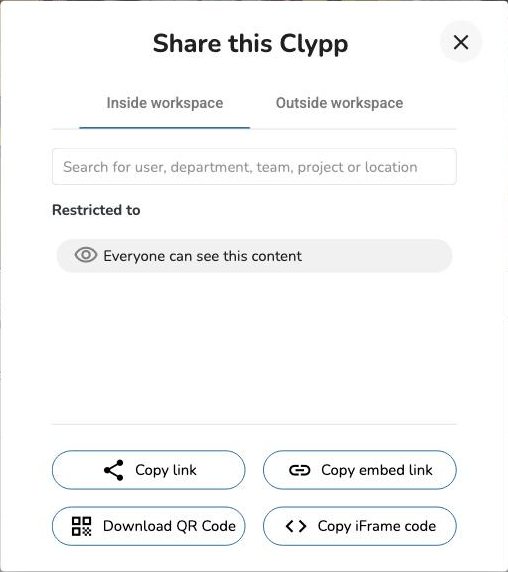
Real views from the Clypp app: how language versions are created and kept up to date, how employees choose their language and how a knowledge question checks understanding.

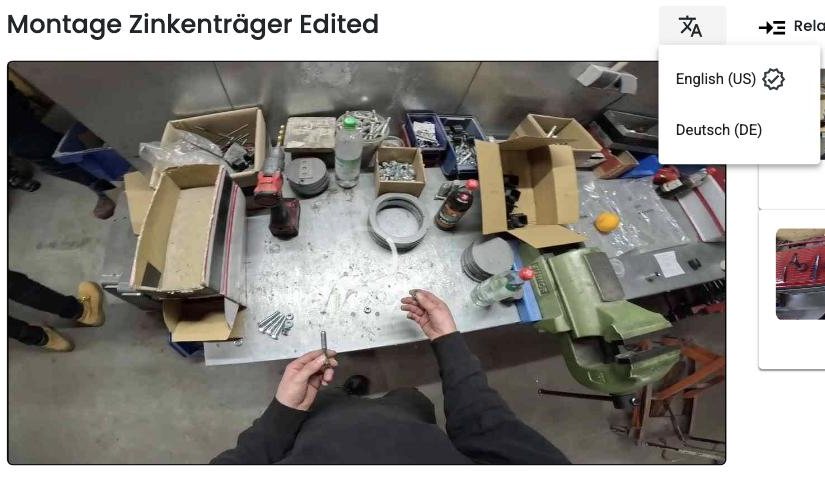

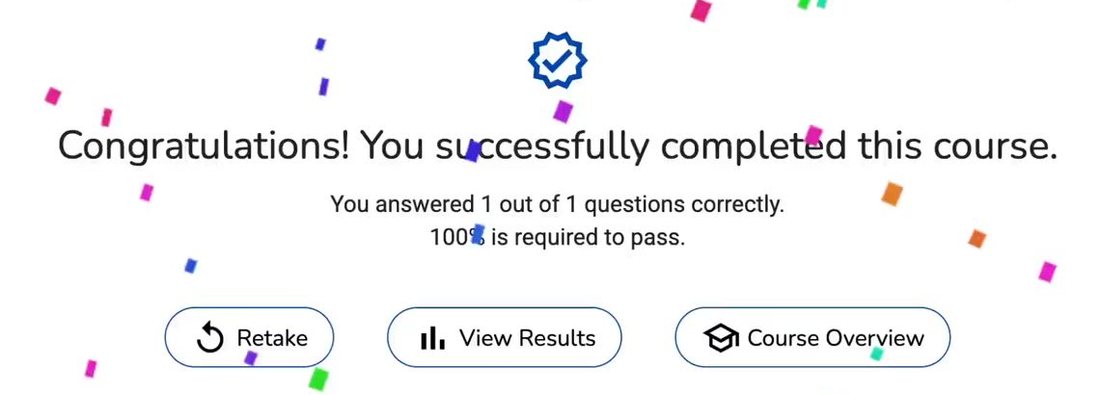
For the check that Patzke calls for, Clypp offers a second layer: the video instruction becomes part of a course with comprehension questions that employees answer in their own language. The result is recorded, and the qualification matrix shows who has completed the briefing and where it is overdue. That does not replace having employees demonstrate the procedure. But it shows early where a follow-up question is needed, even if people nodded during the conversation.
Safety briefings across language barriers
Risk assessment: include communication problems as a possible hazard factor.
Form and language: simple sentences, consistent terms, pictures from your own operation, video where needed.
Delivery: demonstrate instead of reading out, one-to-one rather than in groups, practise emergency behaviour in particular.
Check: have employees show the procedure, explicitly invite questions, have translations cross-checked.
Structures: buddies, bilingual shift leaders, a list of language skills for first-aid situations.
Frequently asked questions about briefings and language barriers
Does a safety briefing have to be in the native language?
Not necessarily. What is required is a form and language understandable to the employees. Whether that works without translation is for the employer to assess and check in each case.
Is it enough to hand out translated documents?
No. According to BGN Akzente, merely handing out documents for self-study is not sufficient. Understanding has to be checked.
Can AI translations be used for safety briefings?
As support, yes. They replace neither the briefing nor the check that it was understood. Simple source texts and a cross-check by speakers of the language increase reliability.
What role do videos play?
They show procedures independently of language and can be watched repeatedly. They complement the personal briefing but do not replace it.
Language barriers cannot be translated away, but they can be made much smaller: with plain language, pictures from your own operation, demonstration and a check that the content was understood. Videos carry the part that can be shown. That is what Clypp is built for: record the procedure once and make it available in the language needed at the workstation.
Show it once, understood in every language.
Where words reach their limits, the demonstrated procedure helps. With Clypp, the work instruction is recorded at the workstation and voiced and translated as a step-by-step video, so the personal briefing has a common basis.
- More than 100 languages: voice-over and translation from one recording.
- The movement on screen: language only carries the explanation.
- Via QR code at the machine: in the language that is needed.
Clypp is a software platform from Germany for video work instructions. In use at RATIONAL, Rosenberger and Elementar, among others.
The voices quoted
Dr. Hannes Patzke
Author in BGN Akzente
Dr. Hannes Patzke is the author of the quoted article in BGN Akzente, the magazine of the Berufsgenossenschaft Nahrungsmittel und Gastgewerbe (BGN) in Mannheim. The BGN is the statutory accident insurer for companies in the food industry and the catering trade.
Nenad Gocevski
Safety engineer at AST Arbeitssicherheit
Nenad Gocevski is a civil engineer and gives briefings at AST Arbeitssicherheit in Serbo-Croatian, among other languages. AST was founded in 2003 by Angelika and Matthias Müller as a training centre and engineering office for occupational health and safety in Blaustein, Germany.
Benjamin Klock
Managing director of Geo Bohrtechnik GmbH
Benjamin Klock runs Geo Bohrtechnik GmbH from Bermaringen together with Jonas Ritter, a technology service provider for specialist civil engineering, remediation of contaminated sites and ground investigation. His quotation comes from the article by AST Arbeitssicherheit.
Sources
- Dr. Hannes Patzke, BGN Akzente, "Trotz Sprachbarrieren sicher arbeiten" (in German), 21 March 2024.
- AST Arbeitssicherheit, "Arbeitsschutz kennt keine Grenzen" (in German), press release, 29 May 2025.
- German Occupational Safety and Health Act, Section 12 Instruction (in German), accessed 11 October 2026.
- German Hazardous Substances Ordinance, Section 14 Information and instruction of employees (in German), accessed 11 October 2026.
- Austrian Economic Chamber (WKO), "Mehrsprachige Teams mit KI im Arbeitsalltag unterstützen" (in German), accessed 11 October 2026.
- FORUM Media, "Arbeitsschutz in interkulturellen Teams" (in German), 6 July 2026.
Draft, as of 11 October 2026. All quotations were verified against the original source, the legal provisions on gesetze-im-internet.de. Quotations marked as translated were given in German in the original. This article is not legal advice.

