
The five things that matter
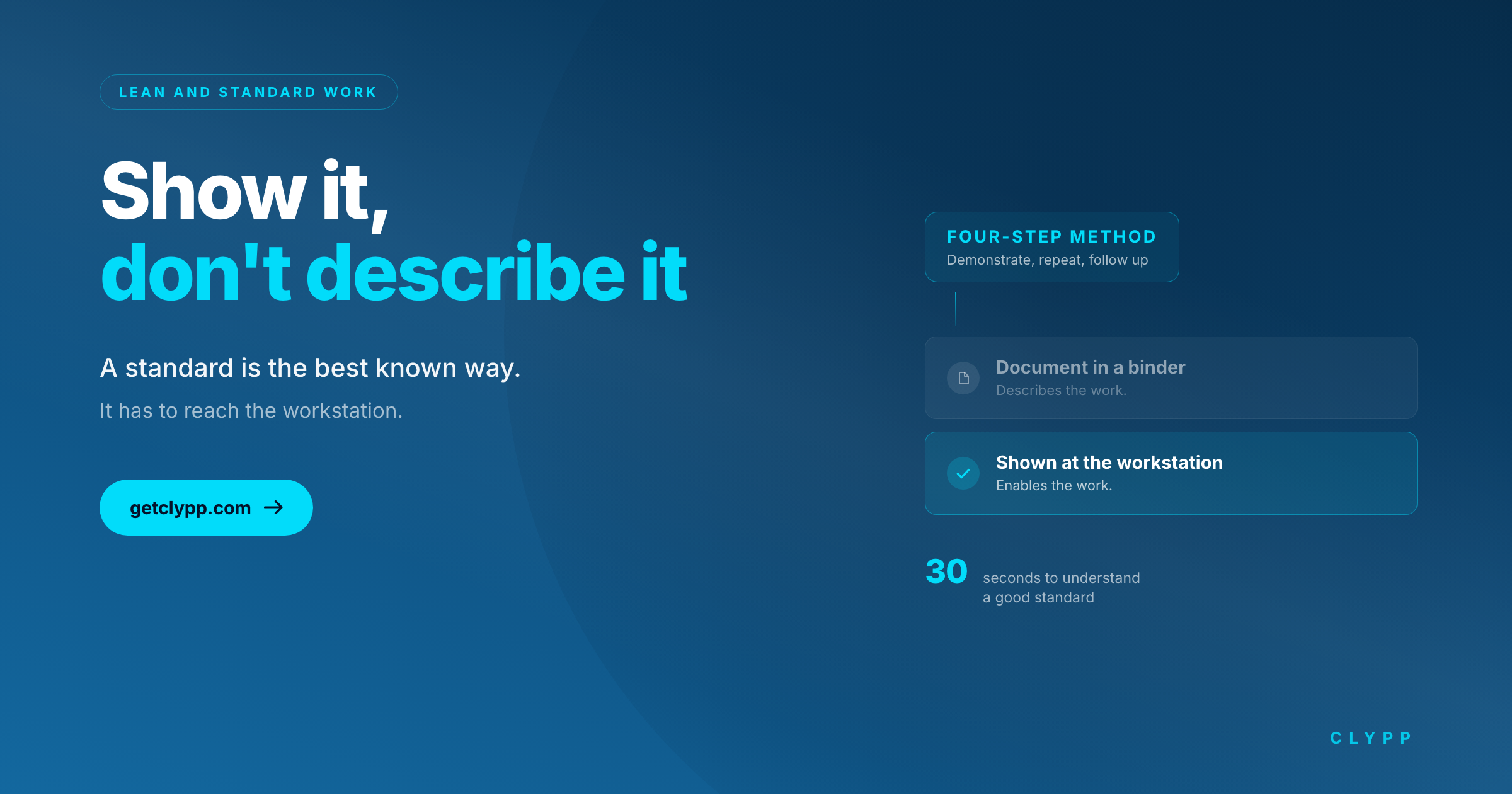
- A standard is not a rulebook but the best known way to do a job today, and it changes with every improvement.
- Many work instructions describe the work instead of enabling it: too general, too long, too rarely updated.
- The four-step method from TWI relies on demonstrating, having the learner do it and following up, not on reading.
- Visual means understood in 30 seconds. Photos, symbols, QR codes and short videos take the standard to the workstation.
- Video does not replace instruction. It captures what was demonstrated and makes it available again after every change.
Almost every manufacturing operation has work instructions. Whether people work by them is another matter. Ask on a line how a particular step is done and you often get as many answers as there are shifts. Lean management has a term for this, standard work, and an old, well-tested method for teaching it.
This article draws on two voices from lean practice: Volker Rozek, lean management consultant and trainer, and the institute OpExinno, which introduces the Job Instruction method from the Training Within Industry (TWI) programme in companies.
What a standard means in lean
Volker Rozek opens his article "Standardisierung: das stabile Fundament für Exzellenz und Verbesserung" (in German) with an assembly line on which every worker had their own way of doing things, with fluctuating quality and rework as a result. His definition counters this:
"In lean, a standard is not a rigid rulebook but the best known way to carry out a task at present."
Volker RozekExpert in lean management and quality management, ROZEK ConsultingTranslated from GermanSource: ROZEK Consulting, „Standardisierung: das stabile Fundament für Exzellenz und Verbesserung“This implies something that gets lost in many documentation systems: a standard is a snapshot. Rozek describes it as living, each with a version, date, author and goal, and as the basis of every improvement. Anyone who improves a standard therefore has to teach it again. Documentation is then not the end point but a recurring step.
Why work instructions often fail to land
On its page "TWI Job Instruction (JI)" (in German), the institute OpExinno describes where conventional documents fail:
"Work plans, standard operating procedures and other documents are often not detailed enough to enable high-quality standardised execution of work. Sometimes they serve more to describe the work than to enable it."
OpExinnoInstitute for Operational Excellence and InnovationTranslated from GermanSource: OpExinno, „TWI Job Instruction (JI)“Rozek reaches the same finding from another direction in his list of typical mistakes: overly complex documents are not read or not understood, and a lack of updates lets standards go stale, which erodes their credibility. The two reinforce each other. A document nobody reads is not maintained, and a document that is not maintained soon has no readers.
The four-step method: demonstrate, repeat, follow up
TWI's answer is not a better document but a method of instruction. According to OpExinno, TWI came to Germany with the Marshall Plan and became known there mostly as the "four-step method of job instruction". In its original field, instruction at the workplace, the method has, in OpExinno's words, somewhat faded from memory in many companies.
The sequence, as described for example by the blog Tägliche Verbesserung (in German): prepare the learner, demonstrate and explain the step, have the learner do it, then follow up until it sticks. The basis is a breakdown of the job into major steps with their key points, the details that lead to errors, accidents or lost time. OpExinno stresses who creates this breakdown:
"Job breakdowns in the JI method are structured work analyses created by the people who do the work, for other people who do the work."
OpExinnoInstitute for Operational Excellence and InnovationTranslated from GermanSource: OpExinno, „TWI Job Instruction (JI)“That is the core of the method: knowledge is captured by the people who can do the work, and captured in a way that lets others do it afterwards. A long prose document written in the office rarely achieves either.
Standard work and work instructions
Standard work, according to Volker Rozek, defines sequence, takt or time, and inventory at the workstation.
The work instruction describes the details of execution, that is, how a single step is done correctly.
The two belong together. The four-step method is how both reach the people doing the work.
Visual in 30 seconds: where video helps
Among the rules Rozek sets out for good standards is one that works as a test for any work instruction:
"A standard that is not understood within 30 seconds is not a good standard. Photos, symbols, QR codes, short videos: visual communication works."
Volker RozekExpert in lean management and quality management, ROZEK ConsultingTranslated from GermanSource: ROZEK Consulting, „Standardisierung: das stabile Fundament für Exzellenz und Verbesserung“Compared with photos and symbols, short videos have one property close to the four-step method: they show the movement in sequence, with the explanation alongside, just like a demonstration. A photo shows the state, a video the way to get there. The key points in particular, such as how tight, in which order, at which angle, can be captured the way the experienced worker demonstrates them.
This is where Clypp, the company behind this blog, comes in. The work instruction is created from a recording made at the workstation, and the software turns it into a video with steps, explanation and voice-over. When the standard changes, the affected step is re-recorded instead of revising a document. That turns updating, which according to Rozek is where many standards fail, into a matter of minutes. More in our article Work instructions 2026.
From demonstration to a standard with a record
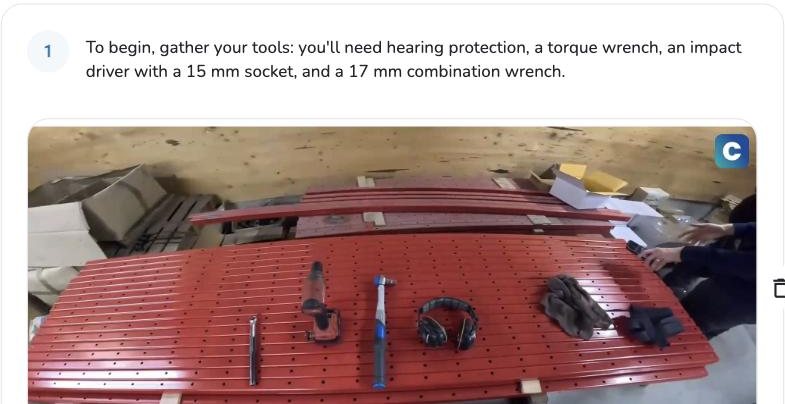
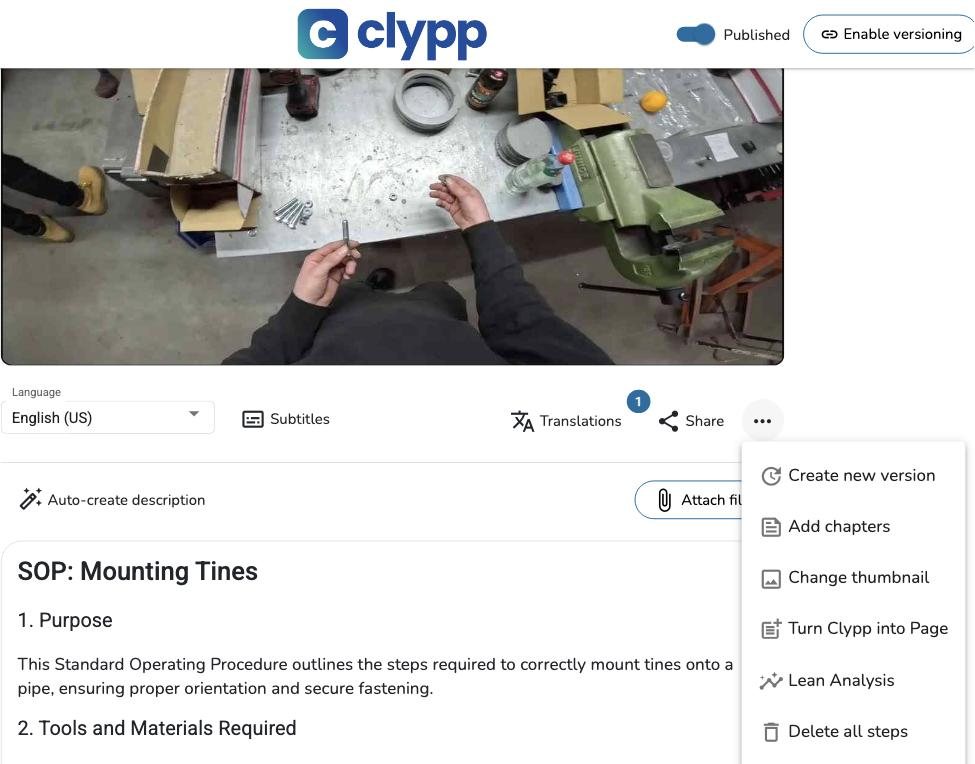
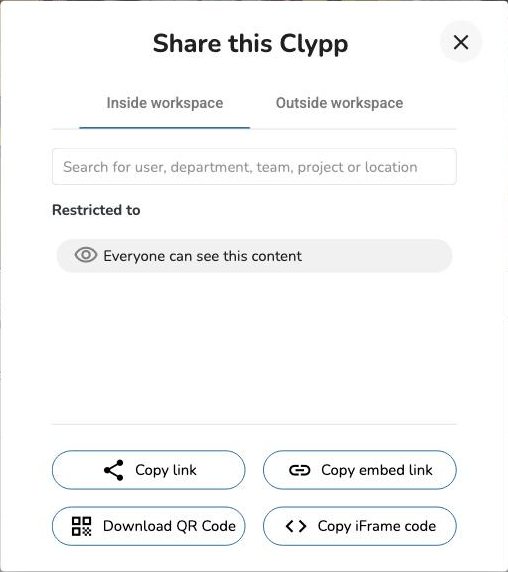
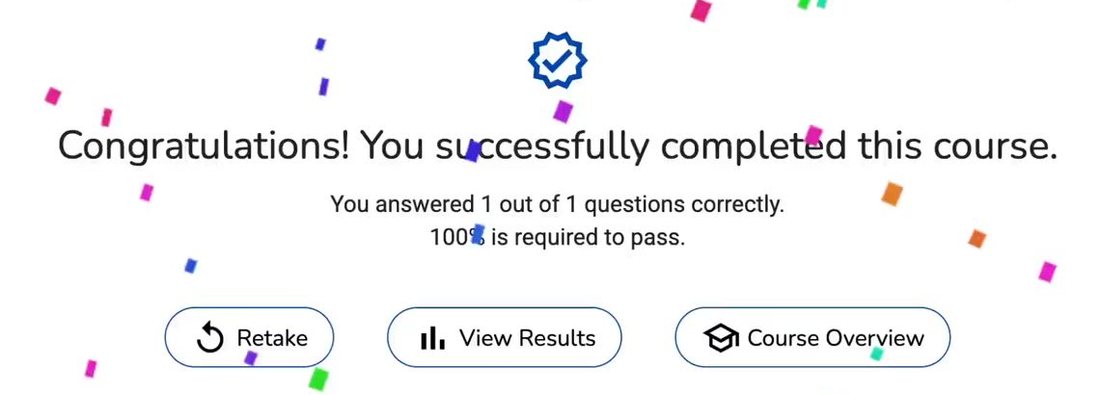
Real views from the Clypp app: how a recording becomes a step-by-step guide, how a new version is created and how training and knowledge checks follow on.

Where video does not replace instruction
A video does not turn the four-step method into self-study. Steps three and four, having the learner do it and following up, need a person who watches, corrects and finally confirms that the job has been mastered. OpExinno points out explicitly that one-to-one instruction costs capacity. No tool saves that capacity.
What a video can do is threefold: it captures the demonstration in the form that counted as the best known way at the last improvement. It is available the second and third time, when the instruction was weeks ago. And it gives the instructor a common basis, so that not every shift passes on its own variant.
Alongside versioning, Rozek explicitly calls a record of training mandatory. In Clypp the two are linked: the instruction becomes part of a course with knowledge questions, the course is assigned as training, and the qualification matrix shows who has completed which training, who is in progress and where it is overdue. A knowledge question does not replace step four, watching whether the movement is mastered. But it shows who knows the new version before anyone follows up on the line.
Frequently asked questions about standard work and work instructions
What is the difference between standard work and a work instruction?
Standard work defines sequence, takt and inventory at the workstation; the work instruction describes how a single step is carried out. The two belong together.
What is TWI Job Instruction?
An instruction method from the Training Within Industry programme, known in Germany mostly as the four-step method: prepare, demonstrate, have the learner do it, follow up.
How often should a standard be updated?
After every confirmed improvement. According to Volker Rozek, versioning and a record of training belong to it.
Does a video replace instruction?
No. The video captures the demonstration and makes it available again. Having the learner do it, correcting and confirming remain a person's job.
Standard work rarely fails because of the idea and often on the way from the document to the workstation. The four-step method answers that with demonstrating instead of reading out. Short videos capture the demonstration, as long as they keep pace with the standard. That is what Clypp is built for: record while the work happens, and re-record the affected step with every improvement.
Capture the best known way before it changes again.
A standard lives from improvement, and so from the new version reaching the workstation quickly. With Clypp, the work instruction is created from a recording on the line, and a change means re-recording the step, not rewriting the document.
- Record at the workstation: by the people who can do the work.
- Steps and key points: structured, explained and voiced automatically.
- Available via QR code: where the question arises.
Clypp is a software platform from Germany for video work instructions. In use at RATIONAL, Rosenberger and Elementar, among others.
The voices quoted
Volker Rozek
Expert in lean management and quality management, ROZEK Consulting
According to his author profile, Volker Rozek is an expert in lean management and quality management with more than 30 years of practical experience in industry. As a consultant, trainer and speaker, he helps companies eliminate waste and establish a lasting culture of improvement.
OpExinno
Institute for Operational Excellence and Innovation
OpExinno was founded by Alexandra Thurnes (managing director) and Christian M. Thurnes and has made TWI Job Instruction a fixed part of its services. The page quoted carries no byline, so we name the institute as the source.
Sources
- Volker Rozek, ROZEK Consulting, "Standardisierung: das stabile Fundament für Exzellenz und Verbesserung" (in German), 18 November 2025.
- OpExinno, Institut für Operational Excellence und Innovation, "TWI Job Instruction (JI)" (in German), accessed 11 October 2026.
- Tägliche Verbesserung, "Mitarbeiter mit TWI (der 4-Stufen-Methode) einlernen" (in German), 1 September 2014, updated 18 April 2016.
- Clypp (the company behind this blog), Work instructions 2026.
Draft, as of 11 October 2026. All quotations were verified against the original source. Quotations marked as translated were given in German in the original.

